
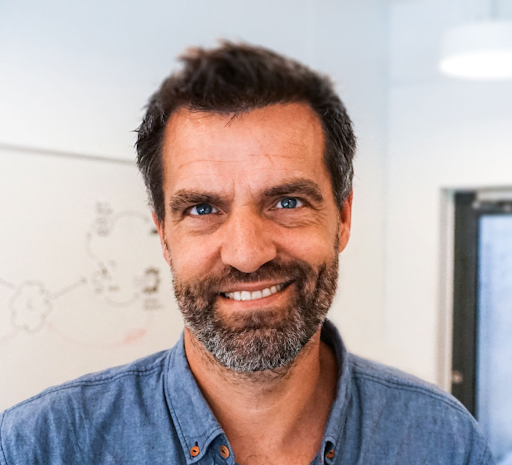
Interview with Søren Würtz, Chief Innovation Officer
Ved Precure
In connection with Business Center Bornholm's recently held event ”The Future is Now”, I would like to know more about innovative businesses on Bornholm. Søren Würtz was kind enough to let me interview him about how he sees his company's place on Bornholm and in the world.
By Mads Voigt Hingelberg, journalist at Innovation Lab.
23 June 2020
In connection with Business Center Bornholm's recently held event ”The Future is Now”, I would like to know more about innovative businesses on Bornholm. Søren Würtz was kind enough to let me interview him about how he sees his company's place on Bornholm and in the world.
Who are you?
“We are a tech company. We are trying to move a manual craft like chiropractic treatment towards a more data-driven approach. So we move beyond a subjective overall picture of a given issue.”
On Precure's website, the company's goal is described as:
”Today, our business is focused on helping people in pain and developing products to prevent pain in the elbow, back, neck, and shoulder.”
What does technology mean to you?
“Tech is important to us. For us it’s also a step towards shifting traditional ways of working into something more high-tech. So we become more precise in our approach. Without technology, we wouldn’t have a business.”
What is it like to run a business from Bornholm?
“The advantage of Bornholm is the accessibility. It is much easier to get to talk to the right people. You can use the network to get hold of the right individuals. That is an advantage; it gives you 2 minutes of extra speaking time. It is also easier to get sparring and advice, and there is slightly less competition when it comes to funding grants.”
What challenges do you experience in your daily life?
“As a technology company, we need to radically change a certain habitual way of doing things and the entire approach to the working environment out in our customers” businesses. And then there is the challenge of recruiting skilled labour. We are on the verge of expanding, and unfortunately we cannot get highly skilled labour to Bornholm.”
What about the physical framework for your work?
“It is not a challenge in terms of physical location. We essentially run our business over the internet, and we use highly specialised employees, many of whom reside in Copenhagen, where we also have an office.”
If I say Bornholm and innovation, what do you say?
“In my worldview, when you are in a small community, you think more traditionally: ”That is the way we have always done it, so we are not going to change that.” Conversely, I see a great desire to relocate some things. Particularly within recent years, the people of Bornholm have realised that they cannot manage without the rest of the world, and that there are plenty of good synergies. Therefore, innovation must come from the bottom up in order to reach the wider world. The innovative part has found a niche on Bornholm, for example the food companies, which have formed their own innovation network."
Now you are the founder of the company and from Bornholm, but what about the other founders?
“All of us founders have a connection to Bornholm as either natives or incomers. Like in all other small communities, you are an ”incomer” even after 20 years. It takes a couple of generations before you are a native.”
Finally, Søren, how do you see the future of entrepreneurship and innovation on Bornholm?
“There is a trend towards more and more innovation on Bornholm. The environment surrounding entrepreneurship has also blossomed. In some cases, it is better than in Copenhagen, but I would like the entrepreneurial environment to become more diverse. Food and drink, super cool, but there is a lack of greater variation and some other elements. After all, people innovate within the areas they work in: school teachers don't invent space rockets, so when there is a lot of agriculture and food on the island, there are natural connections in that direction when it comes to innovation. Generally I think the infrastructure is ok, but there could well be better relations between the Bornholm and the Copenhagen innovation environments - especially regarding specialised labour.”