

Construction company uses recycling as a competitive parameter
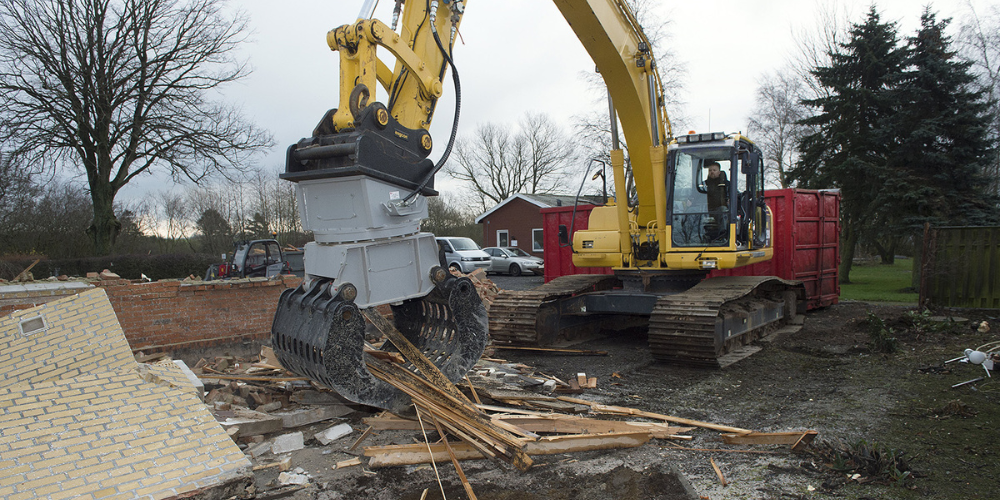
STM Entreprise ApS carries out most of its demolition work as careful dismantling, after which items such as bricks, roof tiles, doors, windows and timber can be recycled, and according to the managing director, this CO2-saving activity has become extremely popular among customers.
When the contracting company STM Entreprise ApS was founded back in 2011, it was forced to carry out a large part of its demolition projects manually due to limited resources. However, this turned out to have a built-in advantage that has today become a central part of the company.
As director, Brian Kofoed, explains: – Back then we didn't have so many machines, so a lot was managed by hand. On the other hand, you got close to the materials and discovered that a lot of it could easily be reused – it was simply too valuable to end up in the landfill.
What is your motivation today regarding focusing on recycling?
– We do that because it is good business. Nowadays, I would actually say that it is more than just a supplementary business – it has become a competitive advantage. When we started doing this, reusing building materials wasn't that widespread, but now it is much more legitimate – it is almost trendy. Therefore, reuse attracts all types of customers. Leaving the financial aspect aside, we also believe, of course, that it is the right thing to do.

We do it because it makes good business sense. Nowadays, I would actually say that it is more than just a supplementary business – it has become a competitive advantage. When we started doing this, reusing building materials wasn't that widespread, but now it is much more legitimate – it is almost trendy. That is why reuse attracts all types of customers. Aside from the financial aspect, we also believe, of course, that it is the right thing to do.
Recently, you had a major demolition project in Rønne Harbour. Did it have a special effect on your recycling approach?
– The port was our latest major demolition project; we had to demolish commercial buildings that were still in good structural condition, but which might have served their purpose. It was an extensive project with a large floor area, and it has really helped us to refine our knowledge and experience; we found new opportunities.
How have you managed to utilise them?
– We threw ourselves into a completely new type of recycling. For example, we cut out concrete elements from walls so that they could be reused as large floor tiles in tool sheds measuring one to two and a half metres. We have also repurposed large quantities of concrete panels from buildings, which are now being used for machine sheds and the like. A couple of years ago, that was just something we used energy on crushing and scrapping.
– At the same time, we have had success with reusing roof trusses, doors and windows, which were somewhat outdated, but still of high quality. Some even came and collected old flooring from a boatyard – they wanted to reuse it in an old agricultural property where they were going to build a flat. We didn't get much for it, but in return they dismantled it themselves.
Is there anything else regarding the project that has surprised you?
– We were genuinely surprised at how much of the building stock could actually be reused. Partly due to the quality of the materials, and partly because many people were curious and dropped by and saw something they could use. For example, old fishing huts that you would immediately think were heading straight for the recycling centre have become cladding timber in many locals' garden sheds – you might just have to cut 10 centimetres off each end, and then you have a board that can be used for another 20 years.
Can you share any specific results or insights from your recycling activities in connection with the port?
–We do not have a direct way of quantifying the CO₂ savings achieved through our actions. For example, when people collect 10 metres of timber, we cannot determine exactly whether they only use three metres. This introduces significant uncertainty into our calculations. Nevertheless, in the Rønne Harbour project, we have carefully monitored what has happened to the materials subsequently, and it appears that approximately 83% of the building stock has been reused.
Can you name a business benefit of your recycling work that one might not immediately imagine?
– Generally, it is a major advantage to have recycling integrated into the business. When visiting a customer, you can offer to reuse their old materials for new projects they hadn't originally planned – for example, a new driveway. It's a very inexpensive and CO2-saving solution. It's a double win-win, because we're already on the job, have the expertise and don't need to drive around looking for new products.
– It also gives a special job satisfaction to contribute to a proper demolition and know that the materials get a new lease of life, and our experience is that it creates a positive customer segment – everyone thinks they win from it, so you might be talked about more by others through word of mouth.
How do you expand your network, and what does it mean for your success?
– A strong network is crucial to our success. We build it through our projects, by meeting people and being active on social media such as Facebook. By now, many people know our company, and they contact us automatically with materials or requests for materials. When we are out inspecting properties, we can therefore also quickly spot something that we know suits this or that customer precisely.
Is that an area you want to streamline further?
– We are currently working on establishing a recycling centre, which requires permits from the municipality. It is a process that takes time, but it will enable us to separate materials and handle hazardous waste safely. All in all, it will allow us to become even more efficient, and perhaps it may generate some new synergies regarding reuse and recycling. Although it can be challenging, we believe it will strengthen our business and contribute to a more sustainable local community.
BY TINA TOFT MØLLER

Brian Kofoed
Director, STM Entreprise ApS
STM Entreprise ApS’ focus on sustainability and recycling illustrates how businesses can incorporate circular principles into their daily operations and make it a profitable venture.
Did you know that...
... reuse and recycling are important for maximising nature's resources, whereas full circularity is comprehensive and requires materials to be reintegrated into nature?
Source: ’Circular economy in construction. With a focus on reuse and recycling of building materials’/Concito
STM Entreprise ApS
was established in 2011 and currently has 28 employees. The company specialises in demolition and recycling, offering everything from total demolition to environmental remediation and the disposal of construction waste and contaminated soil. Their services range from the demolition of detached houses and summer houses to larger industrial and school buildings. By recycling large parts of the demolition materials, the company reduces carbon emissions and lessens the burden on the environment.
See more at stm-entreprise.dk