

Students are a valuable resource for the island's businesses
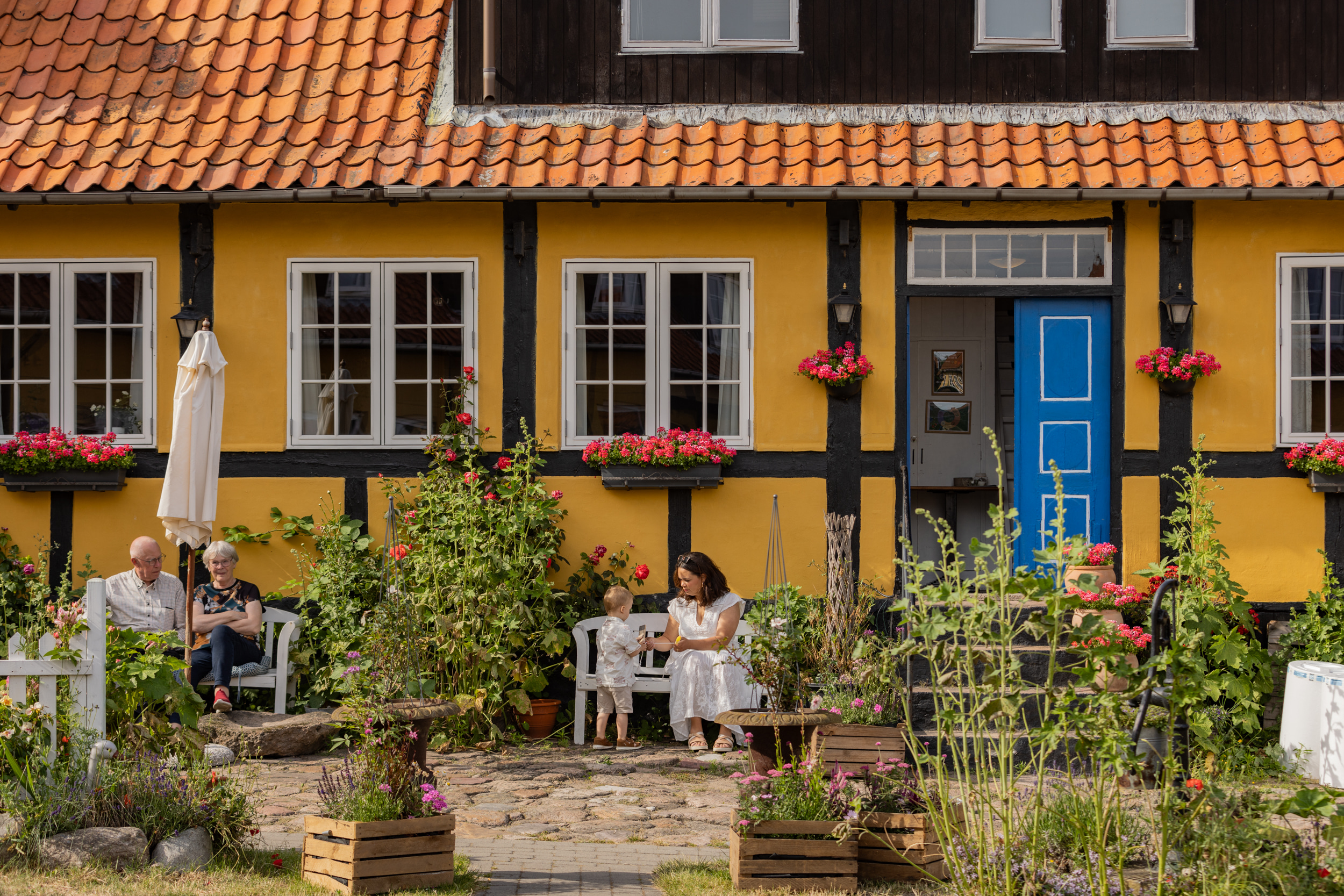
University students have helped the guesthouse in Allinge with the development of a sustainable waste solution. Photo: Justine Høgh
A visit from students doesn't cost a business anything, but it can be worth its weight in gold. And there are good local examples of that.
Young students are the best at picking up new knowledge and technology. Therefore, it only makes good sense to invite talented and inquisitive students into your business when you need product and process development – or simply a fresh perspective on your business case. So believes project consultant Klaus Hansen Petersen from Business Center Bornholm. At the same time, the offer can be used for the recruitment of new highly educated employees and thus potentially new residents to Bornholm. And last but not least, there is a particularly unique opportunity to gain insight into the latest knowledge within the green transition through knowledge collaborations with university students on the island, he says.
– On Bornholm, we are fortunate that a number of universities already visit us and use us as a test island. Especially DTU, among others. And through the EU-supported project »Baltic Energy Island – Green Qualifications«, we can also promote innovation on Bornholm through strong collaboration between students and businesses within green energy, says Klaus Hansen Petersen, who himself helps to create the right collaborations.
– In relation to »Baltic Energy Island – Green Qualifications«, one of my responsibilities is to identify the needs of companies, look into what universities such as DTU have to offer, and then find the right match between company needs and university offerings, he explains.
Free problem solvers
Klaus Hansen Petersen urges companies to be courageous. For a visit from students does not in itself bring about change.
– For one thing, you have to dare to open your doors to these students, which is step number one. That alone does not mean that companies have to implement what the students discover. But it is a catalogue of ideas for moving forward. However, through such visits, you can gain important sparring and vital input regarding new knowledge in the areas concerning the green transition and sustainability.
And there are many ways to do it if you want to get a student into your company, he says.
– This can be done through semester projects, a Master's degree programme or through an internship, where the student goes out and works in the company, gaining an insight into all the company's routines.
That way, there are various ways to land a collaboration, he explains. And which model is the right one depends on the type of task and the company's needs and resources, just as the duration of the students' collaboration with the companies can also vary anywhere from 20 hours to half a year or a full year.
– It depends on the level of innovation you want to achieve. But another option is to start right down at the micro level, where you simply describe the case for the students, and then the students take it from there as problem solvers for that challenge and return after a while with a report.
– It doesn't really take up much of the individual company's time to get involved in a process like that. It only becomes more burdensome if you really need to raise the innovation bar, says the project consultant, who sees it as a valuable resource that the island's companies can get free help to solve specific challenges
or develop new innovative solutions.
– I see it as a gift for Bornholm and Bornholm-based businesses that they can activate the universities and get help and sparring for problem-solving and gain fresh perspectives on their business, while at the same time contributing to the education of the specialists of the future. And you can get that completely free of charge through collaborations with DTU, among others, he says, adding:
– So I think that as a business, you should be open and curious about these offers. The companies on Bornholm that have gained experience with visits from students have given very positive feedback, finding the programmes to have been quite fantastic.
So we hope that other companies also realise the opportunities that this type of knowledge collaboration provides.
Created a new waste system
At the family-run guesthouse Slægtsgården in Allinge, the offer of a visit from university students also made complete sense, as they were in need of a new waste solution for the guesthouse's 28 rooms, says the owner of Slægtsgården, Simon Arvidsen.
– It started with me setting a goal that we should have an environmental certification. And that requires a number of things to be fulfilled, among other things regarding one's waste policy. But when you run a business, you wear many different hats. That means there isn't enough time to acquire all the necessary
competences, says Simon Arvidsen, who through CPH Business was visited by students from environmental technology to have a more sustainable waste solution implemented at the guest house.
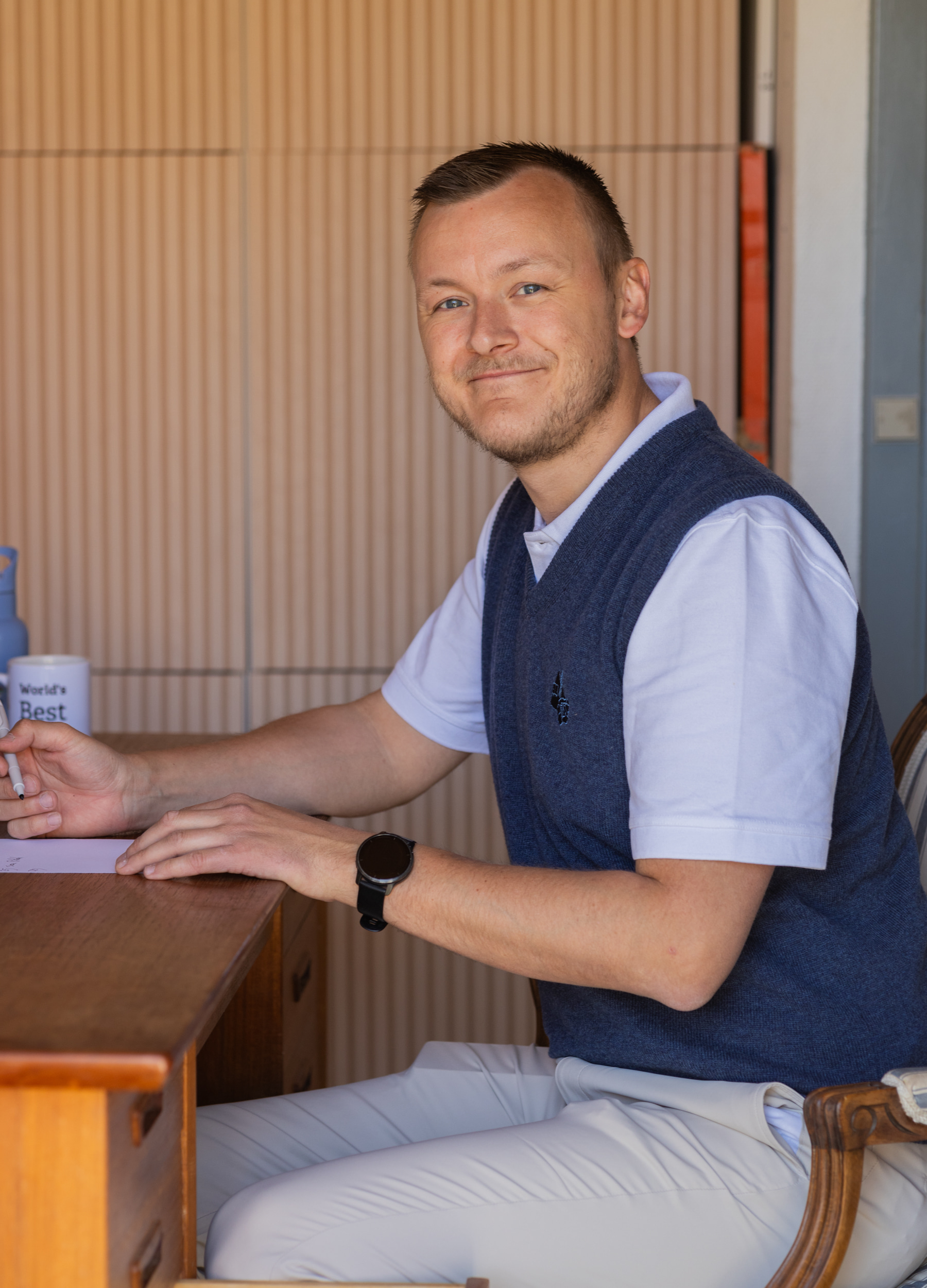
Simon Arvidsen, guesthouse owner The ancestral farm in Allinge. Photo: Justine Høgh.
He judged that the otherwise popular waste sorting solution with a 4-compartment bin at the end of a corridor was not an optimal solution for their type of guests.
– The vast majority of my guests are older people, and if you're seventy-something, you don't go down to the end of the corridor if you've eaten a yoghurt or a marzipan bar at 9 pm. So the rubbish is put in the basket that's in the room.
What knowledge could students give you?
– They had, among other things, a special tool called »The Four Waste Profiles«, where people are divided according to their behaviour regarding waste sorting. To break down the profiles briefly, there is »Idealist Ida«, who sorts rubbish no matter what, »Pragmatic Poul«, who sorts if he is told to, »Convenient Claus«, who does it if it is easy, and finally there is »Apathetic Anne«, who throws it in general waste no matter what, says Simon Arvidsen, who together with the students figured out his own guests' probable behaviour regarding waste.
– Our assessment is that the vast majority of our visitors from the new wave of tourists from Copenhagen are quite idealistic about waste sorting, while many of my older guests, who arrive on the coaches, are in the pragmatic or convenience camp. So it has been about making it as easy as possible without it turning into a big environmental lecture, because my guests are not interested in that either.
What kind of waste management solution have you ended up with?
– I have found a German manufacturer that makes a pedal bin with three compartments, and together with the students I have brainstormed that it will be food waste, plastic and residual waste based on the principle that if my guests have paper and cardboard, they can keep it on the windowsill, says Simon Arvidsen, who is looking forward to testing the new waste system with the opening of this season.
– Following on from the course I've had with the students, it became clear that if we on our part do as much as one possibly can, then we can also help our guests just enough so that the only thing they have to do is hit the right bin and otherwise just enjoy their holiday, says Simon Arvidsen, who has been visited by the students over two sessions lasting two days each during the autumn.
– I think it has been an excellent process. It hasn't cost me anything, but had I hired a consultant, it would have cost a fortune. The new ground-breaking knowledge that exists around the schools is not something I normally have access to. But with a scheme like this, it at least provides an opportunity to implement new knowledge and ways of thinking.
Therefore, he hopes that more people will use the opportunity. And he already has plans of his own to repeat the success.
– It was an awesome experience, and it's without doubt something I'll dive into again when, in a few years' time, I need to redesign our garden so that it has a higher degree of biodiversity. Because there are certainly some students who have knowledge in that area and know how, for example, to get more bees in your garden.
BY JOAN ØHRSTRØM