
From a one-man business to ten jobs and new markets. Other Kofod has on several occasions dared to take the leap with AK Smedeteknik. Along the way, he has learned that growth is not just about getting bigger, but about people, collaboration, and about creating a company that can stand strong, even without him in the middle of it all.
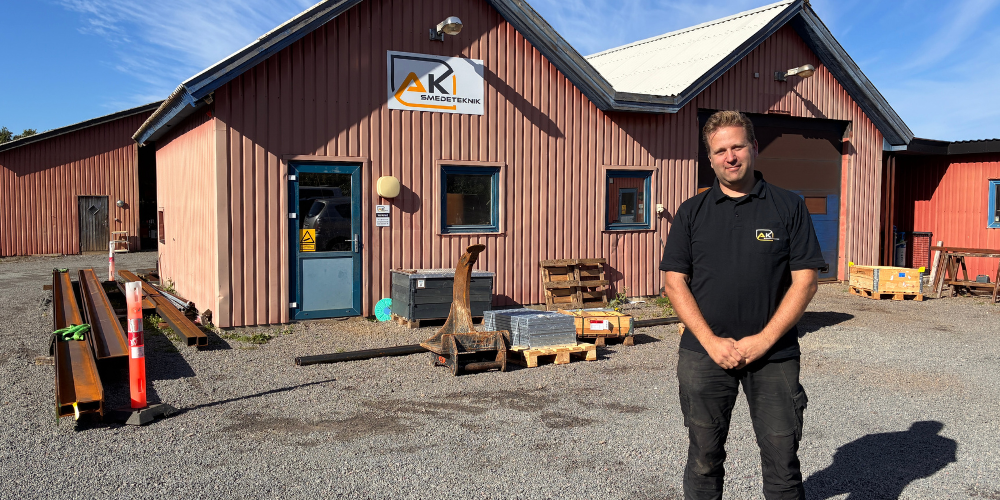
At Klemenskervej 40, outside Rø, AK Smedeteknik has a workshop and warehouse in a couple of machine halls. Next to it is the house where the company’s owner, Andre Kofod, lives. In other words, there is not much of a gap between work and free time. Maybe a little too short. Because it’s not always easy to take time off when the company is right outside your window.
For now, however, the company is staying here. Whether the future means expanding the current premises or moving to something larger at some point, time will tell. Others have not yet laid out the grand master plan for where AK Smedeteknik should be in five or ten years. He has no specific revenue target to reach, nor does he have a goal of the company necessarily having 10, 20, or 30 employees. The goal is first and foremost to create a strong company with healthy growth where people are eager to be part of it.
Started with garden gates
In 2001, the 19-year-old Andre took the plunge and became self-employed. At that time, the tasks largely consisted of garden gates, doors, and other classic blacksmithing tasks for private customers. Gradually, he moved more towards the industrial sector. The tasks became larger, and the customers’ needs were different. Here, it wasn’t necessarily the lowest price that decided who got the job. Because when a machine stands still, time costs money, and it’s far more important who can quickly get it running again.
In 2013, life took a turn for the worse. Others packed their bags and traveled with their wife and their two children to Norway, where the family stayed for five years. Professionally, he learned a lot, but no less important was the fact that the stay changed his view of himself and other people. Something that could previously feel boundary-crossing, such as contacting a large company and offering his services, lost some of its dramatic effect. After all, who really sits on the other side of the table or the phone? In the end, they are just another human being. Directors, buyers, business owners, and blacksmiths are, as Andre sees it, all made of the same flesh and blood. This realization he took home to Bornholm.
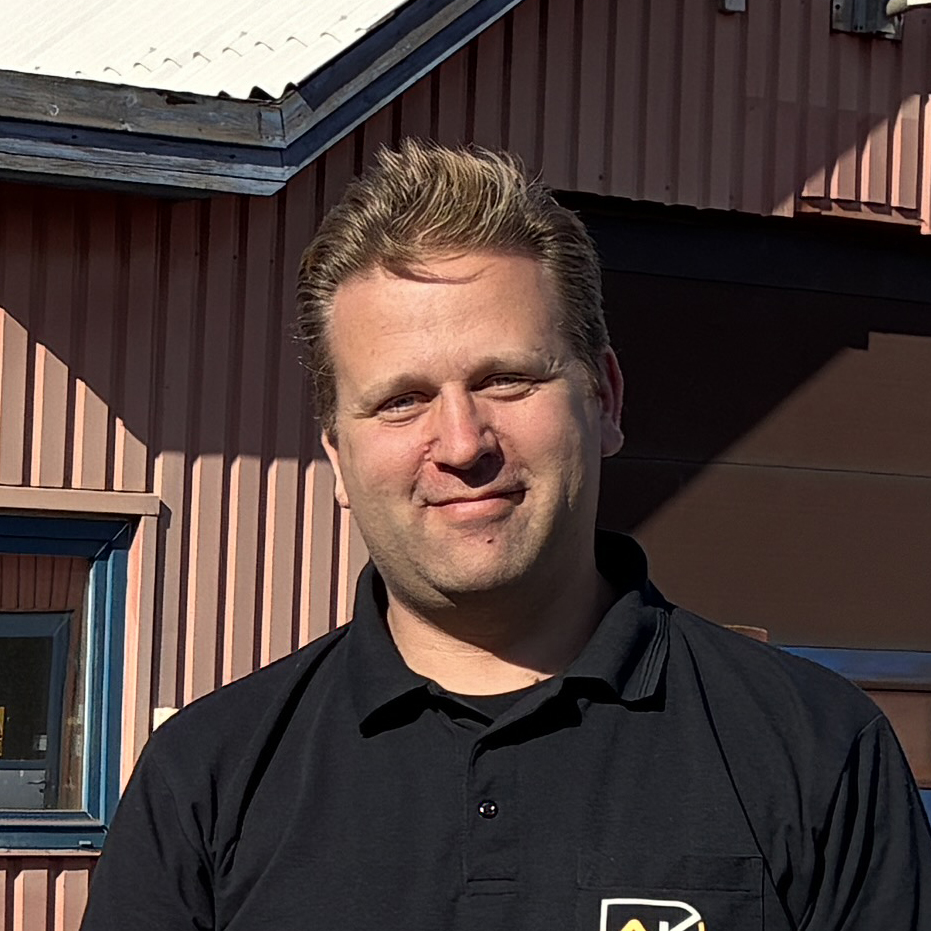
For a craftsman, the idea of office work can be difficult to swallow. The real workday is the one in which you produce something. Where you repair a machine, weld, assemble, and come home after using your body. The person who sits in the office just sits there. Of course, that’s not how reality works. But it has required a mental shift.
The entrepreneurial spirit returned
After returning home, Andre worked at the dairy for a year and a half, but his entrepreneurial spirit quickly began to resurge. He missed the freedom and responsibility of running something himself. In 2020, he therefore deleted his old CVR number. It had been dormant during his time in Norway, but the customers apparently hadn’t forgotten him. From day one, the order book was full again.
In October 2022, he hired his first employee, and the company began to grow. Then, the unthinkable happened.
Three meters down on concrete
In January 2024, Andre was at work as on so many other days. A ladder came crashing down, even though the necessary safety measures had been taken. Andre fell about three meters and landed on the concrete floor. He broke his back.
Suddenly he found himself with a company that was largely built around himself, and a body that could no longer do what it could the day before. He could close the company down. Or he could see the situation as a project in itself and try to build the company up in a new way. Others chose the latter.
He took a position and hired four new employees. At the same time, the accident forced him into a role he had not previously been particularly enthusiastic about: the office.
”For a craftsman, the idea of office work can be difficult to swallow,” he says. “The real workday is when you produce something. Where you repair a machine, weld, assemble, and come home after using your body. The person who sits in the office just sits there. Of course, that’s not how reality works. But it has required a mental shift.”.
Previously, Andre tried to do both. When the company consisted of him and a single employee, he worked outside all day and then worked on offers, invoicing, planning, and the rest of the administrative work in the evenings. That can work for a while. It just isn’t sustainable in the long run.
Ten people have a workplace to go to
Today, AK Smedeteknik consists of seven employees, an apprentice, an office worker and Andre himself as the manager.
At the same time, he has changed his view of what his own task actually is. Spending his day on management, planning, and development is not less of a contribution. On the contrary. Because when the company functions, it means that about ten people have a place to go to work. They can pay their bills, provide for their families, and create a life around their work. It is clear that this is precisely where a large part of the motivation to run the company lies. If the employees are happy, others are happy too. If they are not, he is not either.
Management has therefore become something he actively works on, among other things through the Business Center Bornholm network for leaders, where meeting other business leaders provides opportunities for sparring and developing his own role.
The competitor is also the one you call
This approach to people is echoed when Andre talks about the relationship between the blacksmith companies in Bornholm. Here the contrast becomes clear. In Norway he experienced tough competition, where the companies competed for the jobs. On Bornholm, the competitor is also the one you call when you need a hand.
He doesn’t hesitate to contact another blacksmithing company and ask if they can help with a task or if they can hire an employee with a particular skill set. It works both ways and that’s how Andre would like it.
Island cooperation is crucial
The need for cooperation has not diminished. In recent years, Bornholm has lost its forging capacity, partly due to the closure of Sydhavnens Motorværksted and the acquisition of Baltic Steelwork. Instead, large industrial customers still need the blacksmith to maintain their machines and ensure that production runs smoothly.
Here it becomes clear that Bornholm in many ways is its own business ecosystem. It is not always possible to simply bring the necessary workforce across the water. It takes time, costs money and requires additional logistics. Therefore, the companies are also dependent on one another.
Industry still accounts for the most
Industry still accounts for the vast majority of AK Smedeteknik’s work. This includes machine repairs, construction machinery, tasks for the agricultural sector, and servicing and repairing industrial production facilities.
But every now and then Mr. and Mrs. Jensen still come in the door and ask if Andre can make a porch door or a step ladder. ”It doesn’t necessarily make you rich, but I usually say yes,” he says.
Because Andre knows that the rumor of good work spreads quickly from mouth to mouth on Bornholm.
– People talk to each other. So it’s just as well to make an effort. If you deliver a good piece of work and treat people properly, you’ve both completed today’s task and done something for tomorrow’s order book, he says.
Looking out over the water
The fact that Andre believes in local cooperation does not mean that the ambitions stop at the coast. On the contrary. He has asked the employees how they feel about tasks away from the island, and several are open to traveling out. Sweden is already on the radar, while Norway and Finland could also be interesting.
The focus is also on the opportunities that come with Energiø Bornholm. Others have not waited for the tasks to arrive in their inbox. Instead, he has used the time to prepare. Through participation in a strategic initiative at Business Center Bornholm, the company has obtained EN 1090 certification and has since also obtained ISO 3834-2 certification.
"These are investments in a future that no one yet knows the exact extent of, but which the company is now better equipped to participate in," he explains.
Not growth for the sake of growth
Growing isn't scary for Andre. But growth must make sense.
– I’ve seen companies chase that kind of explosive growth that can lead to a Gazelle award, only to find themselves years later with a business that struggles to keep up with its own growth. That’s not a goal I have, he says. Whether AK Smedeteknik one day consists of ten or 50 people is less important. None of those things scares me.
Caution is generally rarely what keeps Andre back. Or as he himself says with a grin:
– I’m probably the type of person who gets out of the plane first and reads the instructions for using the parachute on the way down.
Experience changes the perspective
After 25 years as an independent entrepreneur, however, the afterthoughts are taking up a little more space. Not least about what he himself should spend his time on.
– We all have 24 hours in a day. For me, management increasingly involves figuring out which of those hours require me specifically, and which tasks others can both do better and enjoy doing more of. There are tasks I’m not good at, and tasks I don’t particularly enjoy doing. If another person is both better at them and downright happy to do them, why should I spend my time on them?
Delegation still doesn’t always come naturally to Andre. But here too he has changed his perspective. Because when he hands over a task, it doesn’t just mean that he’s not having to do it himself. It also means that there’s work for another person. And that’s basically what the company is for, if you ask Andre Kofod.
AF LINA HILDING