

Bornholm is to be the Baltic Sea's beacon for the utilisation of green energy. But why Bornholm in particular? And what does it mean for the island's small and medium-sized enterprises? Minister for Industry, Business and Financial Affairs Simon Kollerup (Social Democrats), Mayor Jacob Trøst (Conservatives) and Chairman of the Board of Business Center Bornholm, Karen Bladt, each give their take on this.
It has been decided that Bornholm is to be the Baltic Sea's beacon for the utilisation of green energy, and in March of this year, with a grant of 27.2 million kroner from the Danish Board of Business Development, the first major step could be taken with the establishment of the National Centre for Green Energy. Overall, the money is to be used to facilitate activities focusing on three tracks: the Baltic Sea as the centre for offshore wind, Bornholm as a test island for green energy, and Bornholm as the Baltic Sea's transport hub.
Thus Bornholm is facing a completely new era, and it is no coincidence that it is precisely the Sunshine Isle that is to help drive the green transition, says Minister for Business Simon Kollerup.
– We must utilise local strengths in Denmark, and with its unique location in the Baltic Sea and the government's decision to site one of the world's first energy islands on Bornholm, the island has every opportunity to become a green frontrunner. This will happen by making Bornholm a spearhead in the development, testing and demonstration of green energy, he explains, adding that the island's local businesses must be involved.
– Partnerships play a crucial role, because we need to work closely with those who know their local area best. I am therefore looking forward to us, together with local forces, ramping up joint initiatives so that Bornholm becomes a leader in green energy for the benefit of both Denmark and the rest of the world.”
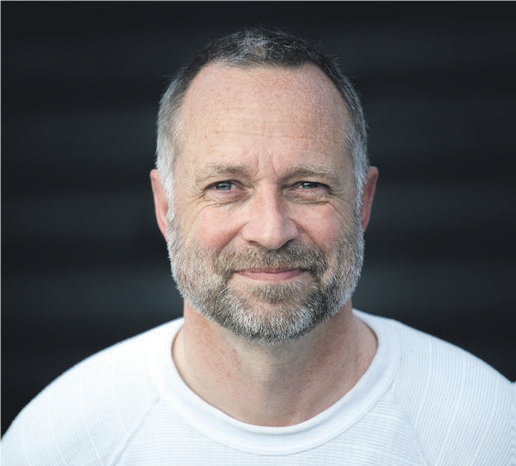
Mayor Jacob Trøst. He is also chairman of the Business Hub branch on Bornholm and vice-chairman of Business Center Bornholm. Photo: Berit Hvassum
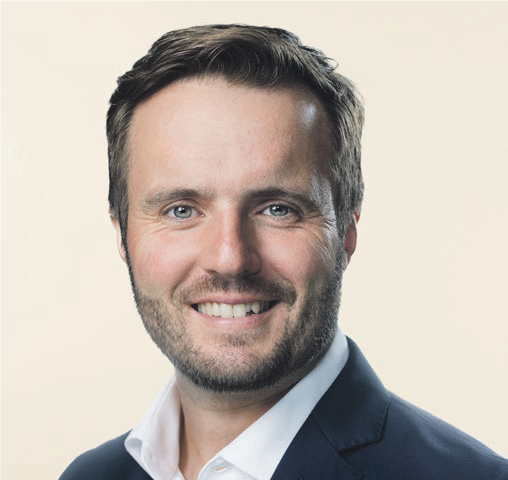
We must harness local strengths in Denmark, and with its unique location in the Baltic Sea and the government's decision to site one of the world's first two energy islands on Bornholm, the island has every opportunity to become a green frontrunner, says Minister for Industry, Business and Financial Affairs Simon Kollerup. Press photo
Business merchandise
Mayor Jacob Trøst is also looking forward to the realisation of the island's potential. – In addition to the Energy Island's 2 or 3 GW of energy production (the final capacity is still being determined by the Danish Energy Agency, ed.), which gives us many business opportunities, we can see that the EU estimates that up to 93 GW of offshore wind farms can be built in the Baltic Sea. Here, Bornholm-based companies can put themselves forward in terms of servicing these offshore wind farms, just as I hope that Rønne Harbour continues to bid for and secure a share of the marshalling and shipping tasks that will follow. From the Ready for Energy Island project, we can see that these orders will also have a positive knock-on effect on Bornholm companies within catering, accommodation, transport and much more, is the assessment. At the same time, he points to the test island activities as an obvious opportunity to boost the green transition and growth. – It is obvious that Bornholm is the place where several of the green solutions of the future are developed and tested. After all, Energinet has announced that it is working on being able to connect the Energy Island's large grid with Bornholm's small grid. When Bornholm at the same time becomes the world's first Energy Island, and we can expect more to follow in the rest of the world, it would surely be obvious for Bornholm companies to specialise in solving tasks for such interconnections, he explains. – We are also looking at the possibilities of utilising the surplus heat that the transformer station will produce so that it can feed into the district heating network. And finally, Rønne Harbour is spearheading a collaboration where we are investigating the possibilities – including in relation to jobs – of creating a green filling station with green fuels for some of the many ships that sail past Bornholm every year. With the green energy from the offshore wind turbines, you can precisely ensure the green transition of some of the heavy energy consumers, such as ships, which cannot simply switch to electricity.
How well equipped is Bornholm's business community to live up to the ambitions?
– Well, I don't know that many of the companies yet. But I understand from the Ready for Energy Island project, which is running now, that the first companies have already started the process of getting the necessary ISO certifications, which some of the new tasks at Rønne Harbour require, for example. And there are also local companies already in dialogue with larger companies within the wind industry, as well as companies in Esbjerg, where they obviously have good experience from servicing projects in the North Sea. So I certainly hope that a lot of the local companies will also be curious about the new opportunities that are coming.
An important tool for Bornholm businesses
That it is a matter of being open, Karen Bladt, chair of the board of Business Center Bornholm and part of the growth team that drew up the recommendations for the Bornholm lighthouse, declares herself to strongly agree with.
– I see very great potential for Bornholm businesses now that we have got the National Centre for Green Energy. It is a game changer that gives our local businesses the opportunity to come in and contribute as subcontractors. However, it is important that businesses are informed about the kind of process we are in the middle of so that they can figure out what role they can play, who they can form partnerships with, and how they get ready. One of the first tasks in the work surrounding the National Centre for Green Energy is therefore the preparation of a so-called roadmap outlining the entire process towards the Energy Island. This roadmap will be an important tool for Bornholm businesses.
Apart from the opportunities to become a subcontractor, it is an advantage that Bornholm will attract competencies and expertise that can benefit Bornholm-based businesses. We will get a lot of knowledge into our system through upcoming study and research projects on the green transition, so it is, in very practical terms, a good idea to reach out and seek help for some of one's own challenges.
What do you say to the criticism that is sometimes levelled at the development plans?
– Everyone was very enthusiastic at the start, and now it's suddenly becoming a reality. There are some practical challenges. Where is the facility going to be located and how big will it be? It's a difficult conversation starting now, but it's important that our society embraces this. There's so much potential in it, so we have to find a solution to the difficult things.
It is said that the green transition will be bigger than digitalisation, and that businesses must drive it – what is your perspective on this in relation to Bornholm?
– I think that is entirely correct, but Bornholm's businesses are small and medium-sized, so it is a very big task that we businesses are facing. Therefore, we are quite dependent on capacity coming in from outside and on being able to apply for funding from various pools, and that is, among other things, what Business Center Bornholm is going to help with. Finally, we can hope to be connected directly to the green electricity. We have all been preoccupied with the green transition for a while now, but with the war in Ukraine, it has become even more important. The time horizon has shrunk considerably. It is not in two years – it is now that we must get started.
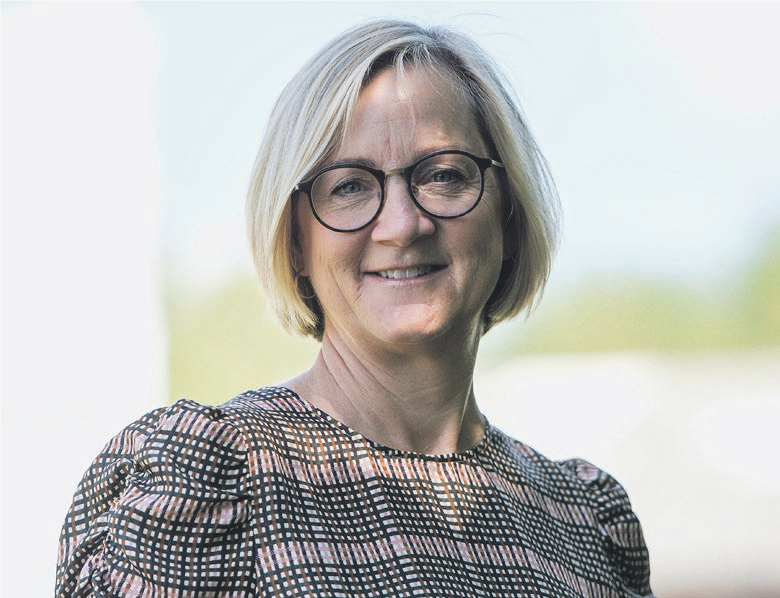
Karen Bladt, Chair of the Board of Business Center Bornholm. She is also Managing Director of HASLE Refractories A/S. Photo: Berit Hvassum