

Wildly brilliant

Bornholm gin producer received a boost with green business development.
Wild Distillery has participated with great success in the business promotion project Sustainable Bottom Line Bornholm (BBB), which between 2017 and 2022 helped more than 50 small and medium-sized enterprises with a business plan that can boost climate-friendliness and competitiveness.
The company has also received an investment grant of 50,000 euros for a new, large distillation plant that can enable greener production.
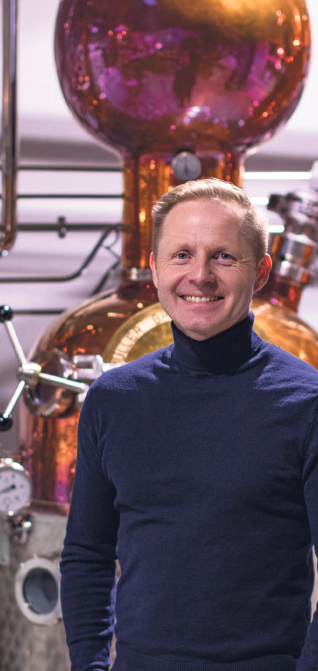
Here, Master Distiller and owner Henrik Nerst tells you more.
– We have factored sustainability into the business from the very beginning, as we are organic. But when you delve into it, there are so many areas you can tackle.
What was the primary reason you agreed to take part in the project?
We were contacted by Business Center Bornholm when word got around that things were going well; we had strong growth and plans to get even better control over sustainability.
– Once you start counting what you have and weighing what you have, it gets really interesting. You can clearly see where you can step in to avoid waste.
Could you tell me a bit more in detail about the BBB process itself?
– We came on board in January 2021 and finished the project last year. It started with a selection process. We wanted just the right consultants to measure and analyse our carbon footprint, and the choice fell on representatives from Niras and Rambøll. After that, a lot of calculations were made regarding, amongst other things, our energy consumption. The result was a report that concluded we could upscale our distillation apparatus. The investment came to 1.2 million kroner.
What made you choose to invest?
– We could clearly see the light at the end of the tunnel. I used a large part of my working capacity on distilling instead of spending time on development and optimisation. The original apparatus ran a very large part of the time, also in the summer when we had over 30 degrees in the factory, so we had to use some energy on cooling down. Now we distil in January and February, when the building is heated by the waste heat, so we save on energy.
So brilliant – and so simple!
Yes. It also works best for me to distribute my work processes better.
Have you collaborated with other businesses and organisations on Bornholm during the project?
– Not directly, but we looked at, among other things, how we could use residual products. That's how we got in touch with Bornholms Mosteri. When they press rhubarb, they have the pulp left over, and we make rhubarb gin out of that.
– We have, of course, ensured that our communication wouldn't be greenwashing, so our communication has grown in line with more and more companies asking about our production.
It is easy enough to say that you are sustainable, but to be able to explain how, to be able to present calculations and say that this is actually correct, that is something completely different. And that is important.
How has the project helped you communicate with customers and society in general?
– We have, of course, ensured that our communication wouldn't be greenwashing, so our communication has grown in line with more and more companies asking about our production.
It is easy enough to say that you are sustainable, but to be able to explain how, to be able to present calculations and say that this is actually correct, that is something completely different. And that is important.
Can you feel a demand for these green initiatives?
– It's coming along gradually, we can certainly notice that. And some companies have a lot of focus on it. For example, we make
many corporate gifts with custom print, and one of our
customers, who are an electrical company, had got a new employee who
didn't believe that gin production on small Bornholm was sustainable
business. Then we could – because we’ve done the legwork
– shortly send our CSR report CSR (Corporate
Social Responsibility), which shows precisely what we do – right from
waste management for heating consumption.
What are your future plans to maintain and strengthen your
practice
– Besides Biogas, we are also investigating how we can
reduce production wastewater. We also think about sustainability
in our purchasing – that is to say: large quantities, fewer times.
We also use FSC-certified cardboard and biodegradable
crisps.
How did this focus on a sustainable bottom line affect Wild
Distillery generally?
– It has given us a head start in being more sustainable,
than we otherwise would have been able to be on the market, so it has given us
a spark – an extra lift!
What is sustainability?
Sustainability is ”the wear and tear of a technology or a culture
on the basis of nature,” whereas sustainable development is to
ensure a reduction of climate impacts and a balanced
resource utilisation.
Source: DTU