
’I understand
the company on a
completely different way now’
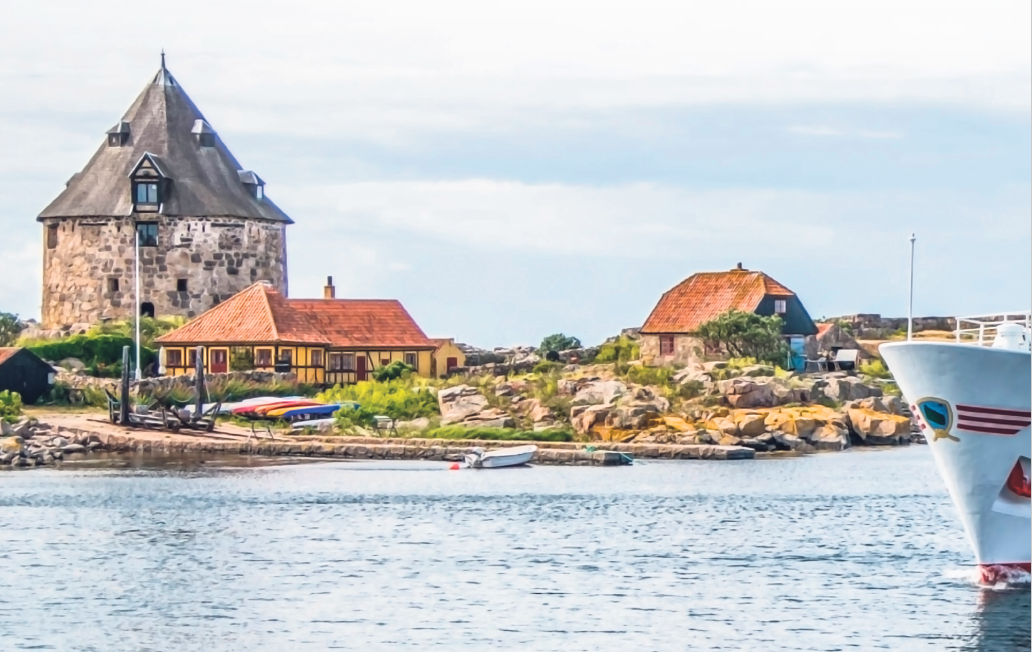
Christiansøfarten ApS gained a new and third co-owner in January 2023 – Simon Damkilde Christensen. As a former employee, he knew the small shipping company inside out, but it was a course in carbon accounting that gave him a truly deep understanding of the company's operations.
Simon Damkilde Christensen has a background as a sailor
consultant in the shipping industry and has previously been employed at
Christiansøfarten ApS – the socially vital connection between
Bornholm and Christiansø. Therefore, it was a ”no-brainer”
to accept when he was offered the opportunity to step into
the board of owners and management on 1 January 2023 in connection with a
generational change.
The first new initiative that Simon Damkilde Christensen took the initiative for
until, was a carbon footprint. Something he decided to learn
to master, because it would require an in-depth data collection
in connection with the operation of the shipping company.
Here he tells more – and about how it all came about.
– I heard about the opportunity to take part in a carbon accounting workshop
through the National Centre for Green Energy and
Business Centre Bornholm during a climate workshop organised
from Bornholm Regional Municipality. It was all very new,
but I realised quite quickly that it was also an opportunity for
to get a proper insight into the whole company, and I was driven
driven by a strong interest in learning all aspects thoroughly to
knew.
Can you tell me about the process – what was it like?
– There was an induction day, where people attended in person at Møbelfabrikken
in Nexø together with the other participants, and it was
A fine start, because you also got to talk to other company representatives.
After that, there was a period of one-to-one sparring,
which took place online, so you could sit at home.
We were also given homework – that definitely helped to motivate us
pushed me extra hard to find the time for the project, because you really felt
a bit, that one had to stand and face the music. All in all, I've probably used 30-40
hours spent diving into the company's figures and vouchers.
– I was a bit sceptical myself – at least at first – because I knew
not all that much about the subject, but I haven't regretted that I
signed up. I understand the company in a completely different way now and actually think that carbon accounting is exciting.
Is there anything about the process that has surprised you?
– I was a bit sceptical myself – at least at first – because I knew
not all that much about the subject, but I haven't regretted that I
signed up. I understand the business in a completely different way now and actually think that carbon accounting is exciting. But I
am also the kind of person who enjoys geeking out over the details.
And as soon as you have tried making your first carbon account,
then fortunately it's easy; you'll get a template for data collection,
which are to be transferred to the Climate Compass, and then it's plain sailing from there
Just from there.
What have you discovered in the process?
– I've found out where the carbon footprint is largest in the company.
It is actually quite important to have knowledge of, for some
often one might think that it is largest in one area, whereas in
reality turns out to be quite different.
– To have knowledge of what the carbon footprint costs in
regarding, among other things, district heating, electricity consumption, procurement of materials and
waste collection is a basis for being able to assess whether there
there are a few points that can be tweaked a bit.
What do you expect of the future as a result of this course?
– In the short term, there are a few areas where we can take action
simply by talking together and changing behaviour. We can, for example
save on electricity consumption and generally be more mindful
on how we shop to avoid waste – or how
We are sailing with the ships to use less fuel.
– I also have some ideas that the Christiansø ferry service in the long term
looking at some green investments with potential support from
relevant funds. Here we just need to wait and see, because right now
doesn't it make sense. As a business, it has to benefit you too
the economy, what you're up to. Unfortunately, you cannot make
something green ”just because”... But there is definitely an exciting
potential.
BY TINA TOFT MØLLER
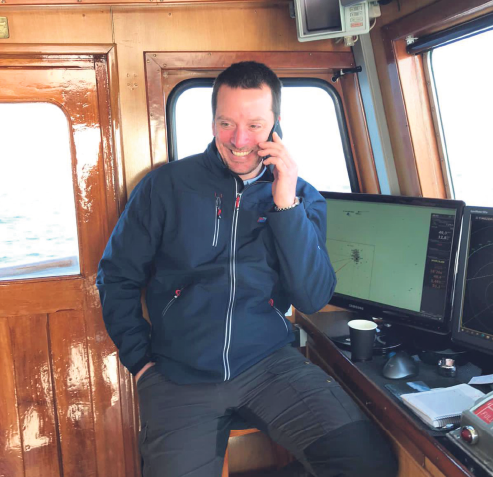
Simon Damkilde Christensen is the new co-owner of Christiansøfarten ApS, which
is one of the country's smallest shipping companies. The route is an important transport link
for the permanent residents on the islands as well as for the nearly 40,000 tourists who annually
visiting the islands. Christiansøfarten has two ships in its fleet, three owners, seven
full-time employees and around 10 seasonal workers. Since joining
Simon Damkilde Christensen has, among other things, taken the initiative with the committee of representatives and management
to have a carbon footprint calculated, and he will continue with that practice.
About the Climate Compass
The Climate Compass is a web-based CO2 calculator that can
make the carbon accounting process easier and provide recommendations
to concrete actions and measures that can contribute to
reduce the company's climate footprint – e.g. by investing in energy efficiency
technology, to increase the use of renewable energy and to
promote sustainable procurement and supply chains. It is developed
by the Danish Business Authority in collaboration with the Danish Energy Agency
and targeted at Danish SMEs.
Source: Klimakompasset.dk et al.