

Kvickly Rønne is to become a test site for loose market without single-use packaging
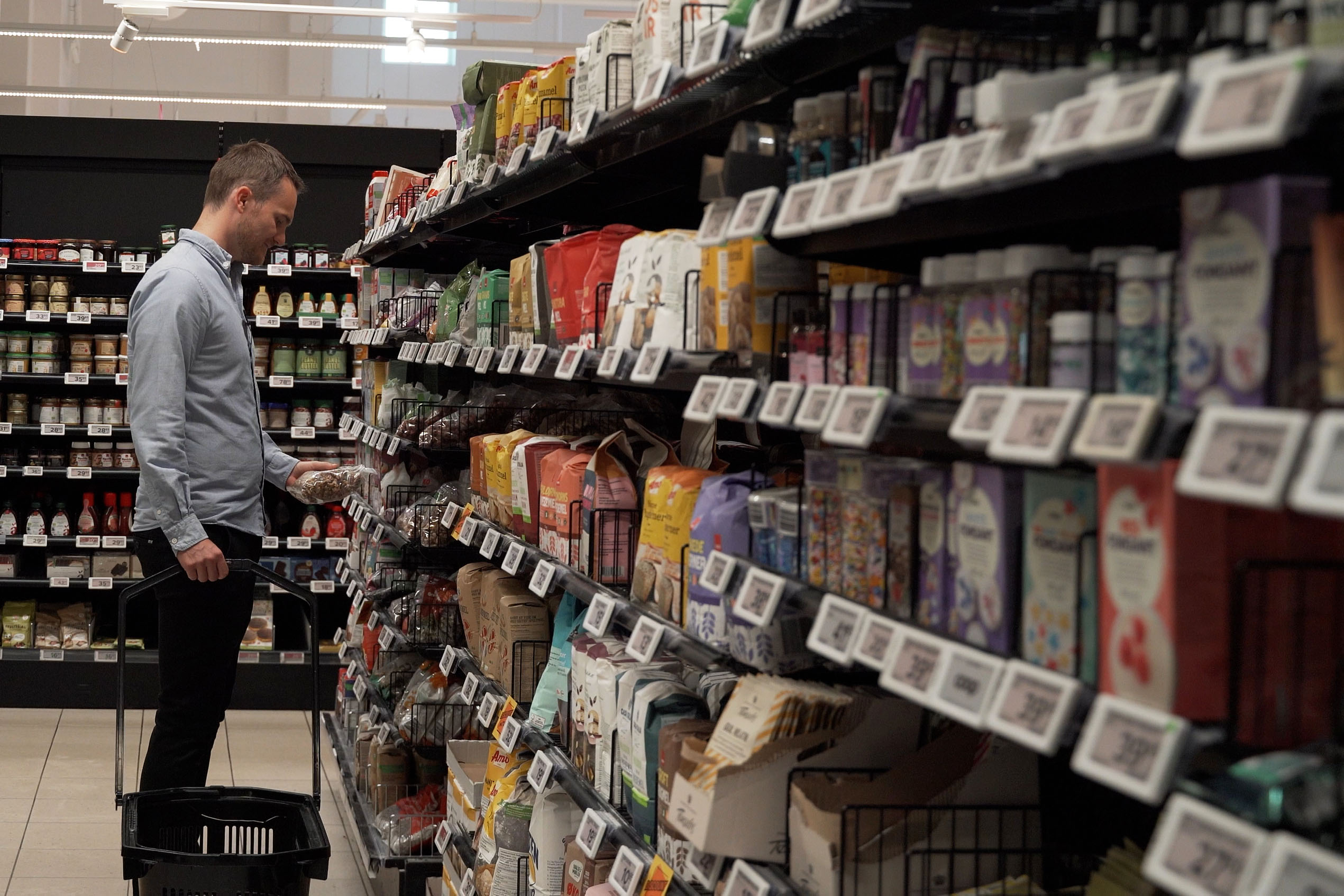
Kvickly in Albertslund. Photo: Coop Danmark
The retail sector uses a lot of plastic for product packaging. However, BOFA and Coop Danmark intend to limit this by testing new packaging-free solutions in an EU-backed project called RELOOPED, with Kvickly Rønne expected to become the island's first test store.
Imagine that you can buy your groceries such as grains, pasta and pulses loose with a concept that is almost reminiscent of pick-and-mix sweets. This form of single-use packaging-free loose sale will most likely soon be explored through BOFA's project Retail Relooped (RELOOPED), which in collaboration with Coop Danmark, Kvickly Rønne and their customers will investigate more environmentally friendly retail concepts through a so-called Living Lab.
For RELOOPED, which BOFA is spearheading, is a major EU-funded project whose purpose is to develop new, more resource-efficient solutions for food packaging within the retail sector. In this way, the project is in line with Bornholm's ambitions for the green transition and its vision of becoming a waste-free
ø i 2032.
Besides Bornholm, BOFA is also the project manager and coordinator for experiments and trials in Sweden, Poland and Lithuania. Thus, RELOOPED is a project that branches out into various tracks concerning plastic packaging from foodstuffs, say Malgorzata Dorota Hojka and Emil-Sebastian Juul-Pedersen, who coordinate the project at BOFA.
– It's about both looking at how we can reuse and recycle plastic as a material, which is being investigated in particular in Poland and Lithuania, while on Bornholm it is about the reduction of packaging, explain the two project managers, and they add that the experiments concerning packaging here on the island are resulting in what they call a Living Lab.
– It's a test where we're trying to rethink the role of plastic, without making plastic something scary, because it isn't. But it's more about only using plastic where it's necessary, says Malgorzata Dorota Hojka, explaining that the plastic in contact with food is food-grade and meets high quality standards.
– It is ideal to avoid unnecessary use of plastic, as it is a limited resource with a significant carbon footprint, she says, adding that recycling is also something they are looking at.
– You can also reuse packaging to a greater extent. We are looking at what makes the most sense and what looks good in the carbon footprint. But the most environmentally optimal solution regarding packaging is to do without it wherever possible. So that is what we are experimenting with.

Project Manager Emil-Sebastian Juul-Pedersen. Photo: BOFA
Want to avoid unnecessary packaging
Together with Coop Danmark, Kvickly Rønne and local food producers, BOFA is therefore investigating which foods can be sold loose and without single-use packaging. Right now, fruit and veg are in play, as are dry goods such as pasta, muesli and pulses. And the whole idea of a single-use packaging-free bulk market is being well received by Bornholm suppliers.
– I think there's an interest in making this work. Because the suppliers would quite like to sell large quantities of dry goods instead of having everything packed down into small bags. That would also make a lot of sense for them, as it's an expense. This way they can reduce costs in the packaging phase, says Emil-Sebastian Juul-Pedersen.
The idea is that the customer brings reusable packaging to the shop, which they fill up via food dispensers for dry goods such as pasta, muesli and pulses. The reusable packaging can be bought in the shop.
Part of the project is also to investigate the challenges that arise when the grocery retail sector has to prepare for new European legislation where more goods must be sold without single-use packaging. Can it make business sense to reduce the amount of single-use packaging by selling dry goods through food dispensers? How great is the willingness of consumers to use such an unpackaged goods market? Which goods can withstand being sold in this way? How costly and complex is a value chain that has to take into account reusable packaging and food dispensers, refilling, cleaning, transport, and not least food and consumer safety? explain the project managers.
– I know at least that one concern for Coop Danmark is whether setting up a system like that is economically viable at all and creates enough value for the customers. It's fantastic that with the project funding they have the opportunity to try it out, says Emil-Sebastian Juul-Pedersen.
BOFA has been granted 4.2 million kroner by the EU for the project, and a smaller portion of the amount has been able to be allocated to the project in Kvickly Rønne, he explains.
– That is also the good thing about having these EU projects, that you get the opportunity to test out something more environmentally friendly that does not necessarily make economic sense. From the EU's side, there are going to be more rules regarding packaging in the future. As part of the EU's upcoming Packaging and Packaging Waste Regulation (PPWR), concrete reuse targets for the retail sector will be introduced from 2030. This means that at least 10 percent of all beverages – both alcoholic and non-alcoholic – must be sold in reusable packaging as part of a return system. The target rises to 40 percent in 2040. However, certain perishable products such as milk and dairy products are exempt. This underlines the need to test and develop new solutions, such as those being tested in Kvickly Rønne through the RELOOPED project, says Emil-Sebastian Juul-Pedersen, before he adds:
As I said, it's not because we are scared of plastic, because plastic can do many good things that protect the product and prevent food waste. But it's a question of rethinking the ways we package things. One example is breakfast cereals, which have both a cardboard box on the outside and a bag on the inside. And there is also a lot of fruit, for example bananas, that are wrapped in plastic. So in the project we would like to find new paths regarding the retail trade's use of plastic. Because for many years we have worked towards a world where we use a lot of plastic. And now we are in the process of finding out if we can do it in a different way, where we use fewer unnecessary resources.

Project manager Małgorzata Dorota Hojka. Photo: BOFA
New waste scheme is an eye-opener
As expected, customers will soon be able to try out the loose-produce market without single-use packaging in Kvickly Rønne. And they are probably more ready for this now than previously, after Bornholm got a new waste collection scheme last year, the project managers believe.
– The fact that we are now sorting a plastic fraction has made many residents of Bornholm aware of just how much plastic packaging one actually has. Most have been surprised by how much it actually is that you bring home when you have been shopping, and then unpack your items almost twice, says Emil-Sebastian Juul-Pedersen, who in that way also sees the timing of the project as favourable.
– It is a good time to tackle that debate. We are not going to save the world with our Living Lab in Kvickly Rønne,
but we hope that people will engage in a way where they give feedback on the project's reusable packaging solutions. We would also like to be able to provide feedback to Coop Danmark that is more qualitative regarding what it is that people experience. In that way, our in-store Living Lab also becomes a kind of anthropological study of what it is people buy and why they do it, explains Malgorzata Dorota Hojka.
– Are there any items that people avoid because there is a lot of packaging on them and so on? We also hope to be able to have that debate during the period when we are going to be down in Kvickly Rønne, says the project manager.
At Kvickly Rønne, they also hope that the project will generate constructive attention which in the long run can benefit both customers and the retail sector.
– The purpose is not to sell a lot of goods. The purpose is to test something out and see if it is viable. And whether it can be developed into something more following the project. So my expectations are to create a lot of awareness around it and test it out and see if it is something that can be further developed afterwards for the benefit of everyone, says Brian Karlsen, who is the local manager of Kvickly Rønne.
BY JOAN ØHRSTRØM