
After a year in the clutches of COVID-19: Now Bornholm's retail trade is ready for action and change
Companies are queuing up to join Bornholm's new structural fund project, which is set to uplift and develop 100 retail businesses
Danish Board of Business Development
9th March 2021
Businesses are queuing up to join Bornholm’s new structural fund project, which is set to boost and develop 100 retail businesses. Business owner: ”We need to go digital and stick together, because customers” habits have changed."
Many Danes have shopped online during the COVID-19 pandemic, and strong indications suggest that these new digital shopping habits will be maintained in the future.
That reality is to a large extent what Bornholm's retail sector is adjusting to through the project ”Restart High Street Business – Responsible Island Bornholm” (GEIG), which the Danish Board of Business Development has supported with DKK 5 million from the EU Social Fund and DKK 1.4 million from the decentralised business promotion funds.
The project is to reach out to 100 businesses in the island's retail sector and held well-attended introductory and launch meetings in January. Here, the businesses were presented with the concept: individually tailored skills upgrades for managers and employees, designed to help businesses meet, among other things, new digital demands from customers. GEIG has since opened for registrations, and change-ready businesses are flooding in, says the island's head of business development.
”COVID-19 has become a call to action for changes in retail. The attitude has shifted from ”we ought to” to ”we must” develop competencies and be more adaptable, says Head of Business Christa Lodahl from Business Center Bornholm and the local branch of Erhvervshus Hovedstaden.
South Funen inspiration
GEIG is inspired by the methods that have produced great results in a similar Social Fund project in South Funen – which is also supported by the Danish Board of Business Development. The common thread in both projects is competency-building courses for businesses and ongoing collaboration with an SME consultant.
All corporate programmes are individually tailored, but in principle follow the same structure: First, the company's need for skills upgrading within relevant topics—such as digitalisation, process optimisation, and the green transition—is analysed. This leads to an action plan where skills training is implemented, and along the way, there is ongoing sparring with a dedicated consultant, as well as the opportunity for micro-mentoring programmes. Once a sufficient number of companies are underway, networking activities are initiated, which have been of great importance to the sister project in South Funen.
Head of Business Christa Lodahl calls the project ”extremely demand-driven”:
”Just before COVID-19 broke out a year ago, we asked the retail sector what was needed, and they pointed to the project in South Funen.”
And when Business Center Bornholm in December – before retail was shut down – contacted a large number of businesses to present the final project, the reactions were overwhelming, says Christa Lodahl: ”Many owners expressed their delight that an initiative for retail was finally underway, and they were particularly pleased with the consistent figure that a dedicated consultant represents.”
Many business owners feel challenged by the changes brought about by the COVID-19 pandemic. One of the project's two business consultants, Cindie Dahl Rode Hiort, elaborates:
”The customers who usually shop online have done so even more, and those who usually visit a physical shop have figured out how to shop online. Many business owners feel pressured by the increase in online shopping. ”Should we set up our own webshop and at what level,” they ask. Furthermore, quite a few businesses are digitally challenged on a very basic level, for example, they do not even have a website.”
Trend: More digital and more local
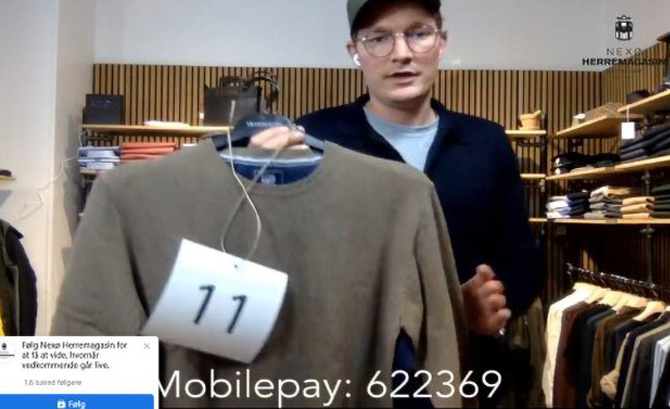
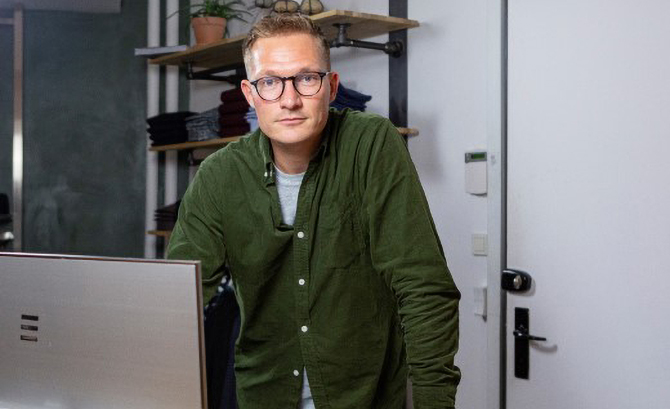
One of the island's business owners, Magnus Dyrmose Stegmann, who owns Nexø Herremagasin, sees two trends born out of the COVID-19 crisis: more digital customers and a growing tendency to shop locally.
”Businesses need to become more digital – who knows if a new epidemic will hit in two, five or ten years. No one wants to risk not being able to service their customers anymore. Furthermore, we have now lived with COVID-19 for a year, during which customers have got used to operating digitally.”
Magnus Dyrmose Stegmann, who has a career behind him in the clothing industry outside the island, has returned to his hometown and took over the men's outfitters in 2019. He acknowledges the challenges facing retail, but also sees opportunities:
”There is a growing tendency to shop more locally, and when the retail sector reopens, many will head to local shops. We could feel during the Christmas shopping period that people have started to realise that their town and local area are important – and that they contribute to growth and prosperity by shopping locally.”
For Thomas Thors, mayor of Bornholm Regional Municipality and chairman of the business hub branch on Bornholm, GEIG is a very major asset which is pushing Bornholm's vision work leading up to 2028. Among the visions are 1,000 new job openings, new and attractive housing and residential areas across Bornholm, as well as making Bornholm the attractive choice for newcomers, tourists and businesses.
”We are a vibrant island community, and that is why we need projects like GEIG. It is not just about a few businesses selling us goods – there is much more to it: We need an attractive and vibrant town life for our residents, newcomers and tourists. In other words, GEIG is important not only for retail, but also for the island’s housing and job creation,” says the island’s mayor.
About ”Restarting street-level business – Responsible Island Bornholm” (GEIG)
GEIG is to implement individually tailored skills upgrades in Bornholm's retail sector – including in digital transformation. 115 managers and employees in 100 businesses are expected to participate, and 90 of them are expected to have their skills strengthened.
GEIG, which is supported with approx. DKK 5m from the EU Social Fund and DKK 1.4m from decentralised business promotion funds, is one of eight projects that the Danish Board of Business Development chose to support in September 2020 as part of the initiative ”The skills of tomorrow”.
In December 2020, the first activities got underway, and the project finishes at the end of December 2022.
Business Hub Greater Copenhagen operates GEIG in partnership with Business Center Bornholm, local trade associations, industry organisations – including the Danish Chamber of Commerce – and Bornholm Regional Municipality.
Read more about GEIG on the project website