

Reel software development requires
enthusiasts and local support
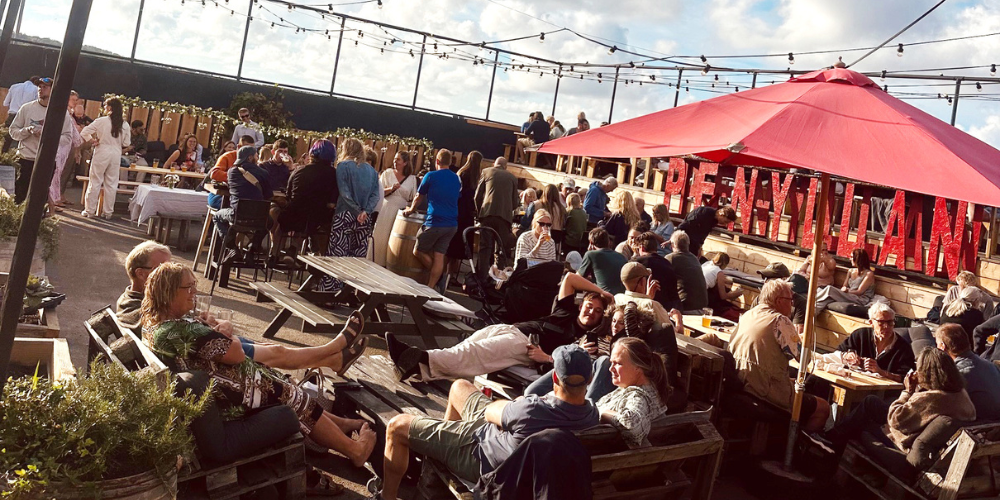
There is something good brewing in Tejn, where quality beer is brewed – and much more.
For the harbour town has reinvented itself following the downturn in fishing, and new businesses have blossomed.
Tejn Harbour was once characterised by a bustle of fishing cutters. In the heyday of the fishing industry, the town was Bornholm's third-largest industrial harbour. However, many did not give the port town much chance as a commercial town when fishing suddenly disappeared during the 1990s, transforming the once-flourishing port town into a somewhat sleepy coastal town that was an excursion destination for very few. Yet over the past 10 years, Tejn has shown signs of a true transformation, with both enterprising business owners and tourists returning to the old fishing village, which seems to have reinvented itself. Senior researcher Andreas Skriver Hansen from the Centre for Regional and Tourism Research (CRT) has followed this development from the sidelines, as he is from and lives on the island.
– What we can see is that tourism has truly established itself in Tejn with new experiential content, says Andreas Skriver Hansen, adding that tourists also have more reasons to stay in Tejn. Not just to eat bread from the bakery and pizzeria Brødre, which has achieved almost cult status, but also to eat at the town's restaurants or at Smedjen on the harbour – a food hall with beer, food and concert activities in the high season, where the harbour environment is now being utilised in a new way, he says.
– The old fishing backdrops are still present in the form of the harbour and its old fishing buildings. They are no longer in use, but they provide the framework and atmosphere for tourism content and, not least, a story about the development of the harbour and its connection to the Baltic Sea, which tourists naturally tie together with the experiences associated with it, says the senior researcher, adding that Tejn Harbour in this way gives tourists a historical backdrop that appeals to many.

What we can see is that tourism has truly established itself in Tejn with new experiential content. Tourists also have more reasons to stay in Tejn.
Growth tape
He attributes the success not least to the many local enthusiasts who have transformed the harbour with new initiatives, just as local residents and community life have helped to drive the development forward. But it has been a long process, points out Andreas Skriver Hansen, who sees Tejn's development as a good example for the rest of the island. In addition, there is the importance of remembering that this is a very place-specific development, he points out.
For many years Tejn was overlooked by tourists compared to its neighbours Allinge-Sandvig and Gudhjem, which have always been some of the island's classic tourist gems. But Tejn is, after all, still a coastal town, and that has many advantages. By comparison, it takes more to attract tourists to the towns in the interior of the island, so what has been possible in Tejn does not mean that the same would be possible elsewhere on the island. One must work with and from the locations and local conditions that apply.
Added to that, there will also always be a difference between individuals and process in such transformations of areas, explains Andreas Skriver Hansen, who assesses that for a time we have been in a kind of transitional phase when it comes to the combination of the island's tourism development and future urban development.
– Some local communities stand, and have always stood, a little on their own two feet. These are the usual tourist towns – Allinge-Sandvig, Gudhjem, Svaneke, Snogebæk and Rønne partly too. Conversely, the towns in central Bornholm have had a harder time compared to the coastal towns. But that is possibly turning around now, not least thanks to initiatives like the »4-clover cluster« and the work done on the Green Wave years ago, he says.
– Here, for example, one has the opportunity to focus on nature and outdoor experiences, which people also find attractive. Looking at these initiatives, I am quite optimistic regarding the towns that have traditionally been challenged. In addition, there are new tourism development ideas and plans for parts of Midtøen, says Andreas Skriver Hansen, who points out that a potentially interesting development may be underway in that regard.
As for the island's other urban communities, they would benefit from taking inspiration from Tejn as well as other coastal towns on the island where urban development has taken place in a style similar to that in Tejn, he believes.
– Aarsdale is probably the most classic one to compare with, also in terms of size, but there is also Nexø, which is a bit bigger. Here, the narrative is the same in that the old fishing industry, which has been phased out, still forms a backdrop. There is space and land where it has been possible to create something new – buildings and old infrastructure that have been reused in a different way by thinking outside the box and transforming the content into something modern and contemporary. This provides some new perspectives and opportunities.
Long-term perspectives are necessary
Regardless of location, however, he points to one decisive factor if you want to ensure good urban development like in Tejn:
– Enthusiasts! You need people who dare and want to work for the development of local environments. There must be some who take the initiative and lead the way, and who can make things happen. And then it must also be someone who has an eye for collaborating across sectors and at multiple levels – including the local authority.
At the same time, there needs to be people who both have an eye for economics and a degree of realism, believes the researcher, who also sees Tejn's development as an example that good development can take a long time.
– It is important to take a long-term view, because real urban development does not happen from one year to the next. Therefore, one must think in 5-10-year perspectives and plan accordingly, says the researcher, adding that urban development first and foremost also requires support from the local population and decision-makers, so that those with good ideas are given the opportunity and tools to put them into practice.
The customers came by themselves
In Tejn, one of the local entrepreneurs who has breathed new life into the harbour with a good idea is Christian Skovdal Andersen, who, together with his wife, is behind the Penyllan brewery.
– My wife and I moved to Bornholm with a passion for starting a brewery, where we wanted to produce beer by wild fermentation. Nobody else was doing that in Denmark at that time. And on Bornholm, it was possible to set up on a small budget, says Christian Skovdal Andersen, who has also benefited from the local plants, berries and fruit that he uses in the production of the beer, which undergoes wild fermentation in wooden casks in the same way as wine.
However, the Penyllan brewery is today not only a production site, as it was originally intended when it opened in 2015.
– At that time, Tejn wasn’t a place people passed through, so the beer we brewed we sent primarily to customers in Copenhagen. But gradually people came and tapped on the window, remembers the brewer, who in the beginning simply set up a draught beer system for the most interested. Later on more and more came, and he had to build a bar counter out of chipboard and pallets. Now suddenly he had seven beer taps for the thirsty customers. And the corona crisis the following year hit the brewery favourably, because it made many more people come to Bornholm.
– We got a huge number of visitors. Where the season normally is only the month of July, the season suddenly started in May and lasted until October because people went to their holiday homes and were able to work from home. Whether they got any work done, I don't know, but they certainly got through a few beers, says the brewer.
Many thousands of visitors pass through our shop and bar every year, and with the new premises we have the opportunity to extend the season.
Mopeds and pub apartments
In 2019 he also began experimenting with beer tastings and guided tours and with proper opening hours instead of just opening when people dropped by randomly.
– Tejn was certainly not a trendy place when we arrived. It was very desolate. The harbour master at the time had clearly seen that fishing was a dead duck in Tejn, and he was sad that the harbour was just going to silt up. But now we've found a good path for development here, says Christian Skovdal Andersen, who in the summer of 2025 was able to expand his brewery into new premises, just 50 metres from the old ones. And now sales no longer come solely from Copenhagen restaurants, but also from their own shop and bar on the harbour.
"Many thousands of visitors pass through our shop and bar every year, and with the new premises we have the opportunity to extend the season, both because there is more evening sun and because the new premises are well insulated unlike the old ones – meaning we can also introduce new initiatives outside the peak season," says the brewer, who is delighted with the life now buzzing from their former production premises.
On the 1st of March, a tenant with the company Puch Maxi Tours moved into the harbour, he says, so that you can now also hire a moped from the place, and if you have drunk too many beers to ride one of those, the brewer is now, together with another partner, also building holiday apartments above the pub following the British model.
– Nobody else does that in Denmark, but if it works in Britain, I thought, why shouldn't it work for us here, asks the brewer, who is thus also contributing to Tejn's urban development in an upward direction – literally.
BY JOAN ØHRSTRØM