


Recycling in the world of ceramics
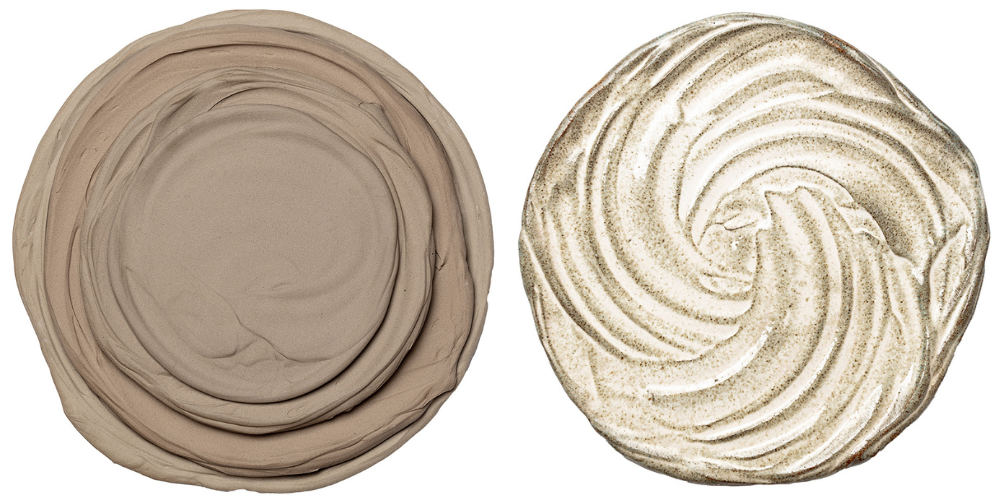
Examples of surplus materials from ceramic production being tested for recycling possibilities. Photo: Kasper Agergaard
Surplus clay slurry from ceramic workshops, a crushing machine, and discarded old glass and porcelain are among the elements that help Christina Schou Christensen from CSC Keramik/Dansk Kaolin to create green innovation within her craft.
It was one of those days in 2021 when the summer heat beat down unbearably. Ceramicist Christina Schou Christensen had left the workshop's slip bucket outside because of an unwelcome odour. In the bucket were, as usual, mixed surplus materials from production that were supposed to be taken to the tip, but due to being busy it was forgotten and left out in the sun. – The next day I discovered that the contents had acquired a fantastic consistency resembling the most delicious whipped cream, says Christina, who couldn't resist trying to throw it in the kiln. – To my great surprise, it came out with a really beautiful khaki colour, and the smell of all the organic matter had disappeared in the firing. Christina was thrilled and didn't hesitate to make arrangements with other ceramicists on the island to take over their clay slip on an ongoing basis. – For example, I've received some in a very light colour from a colleague, from which I've created some really beautiful plates for the Baltic Energy Island foundation, who wanted a tableware set based on recycling principles, she says, emphasising that the clay slip is still in an experimental test phase, where it is sent back into circulation if it doesn't behave as desired.
Ceramics is a craft that requires many – and special – resources, but we cannot keep digging in the ground for what we need. Lithium, a traditional ingredient in ceramic glaze, has, for example, become so rare and expensive that there is no future in using it, but at the granite quarry in Rønne there is an alternative source: granite dust. It is so fine that the quarry cannot use it for anything, and it turns into a beautiful glaze when mixed with water – an old Bornholm tradition.
Alternative resources
Through her studies of the history of ceramics, Christina has also discovered that in 1920s Paris, it was common practice to include up to 20 % of crushed porcelain in glazes. ’I was really excited to discover this, and one day I thought it was time to do something about it rather than just talk about it,’ she explains. In 2022, therefore – with support from, amongst others, the Danish Business Development Board and LAG Bornholm – an advanced crushing machine costing over 300,000 kroner, which made it possible to extract powder for clay bodies from recyclable materials such as glass and porcelain. “It was a very expensive machine, but it can do everything I ever dreamed of,” she says. And it wasn’t just a matter of upgrading her own workshop; it was an important step towards innovation in the ceramics industry. The Royal Academy of Glass & Design in Nexø, where she teaches, was even inspired by her initiative and invested in a similar machine. – For the school, it’s not just about living up to the UN’s Sustainable Development Goals, but also about giving students a deeper understanding of the potential of the materials. It really makes sense. What’s more, I love seeing how others are inspired and can become part of a new wave,’ she explains, adding: – Ceramics is a craft that requires many – and specialised – resources – but we cannot keep digging into the ground for what we need. – Lithium, a traditional ingredient in ceramic glazes, has, for example, become so rare and expensive that there is no future in using it, but at the granite quarry in Rønne there is an alternative source: granite dust. It is so fine that the quarry cannot use it for anything, and it transforms into a beautiful glaze when mixed with water – an old Bornholm tradition.
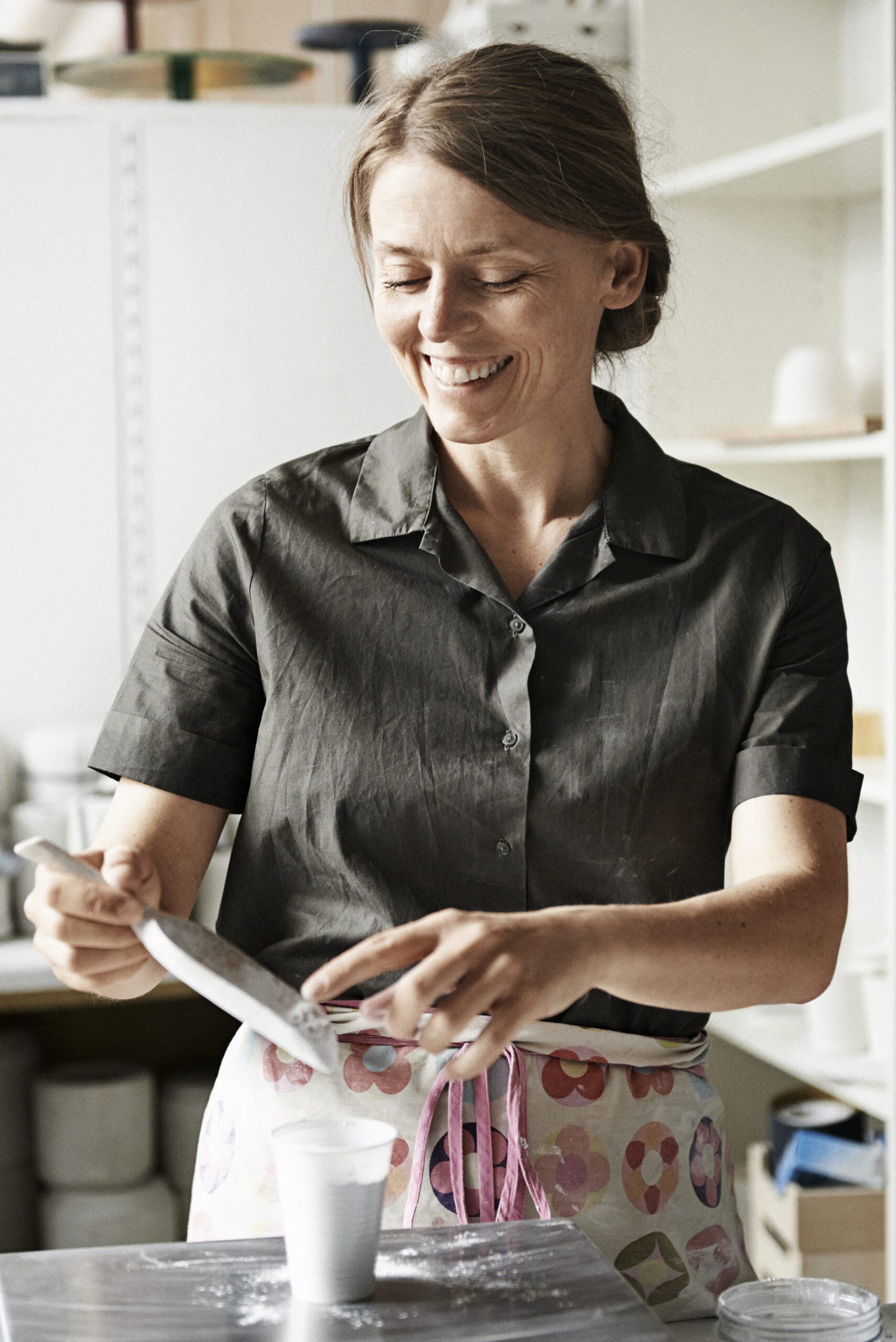
Christina Schou Christensen, owner of CSC Keramik/Dansk Kaolin.
Photo: Bo Johannsen
Strong interest in collaboration
Following an initial period of technical challenges, Christina’s machine has been running at full capacity for almost a year. She is currently approaching the exciting conclusion of a project for a Copenhagen-based plant pot company. The company found Christina through Sarah Oakman, having expressed a desire to recycle the pots that, unfortunately, break in their warehouse. – I thought it would be easy, and that I could recycle up to 80 %, but it has been a challenging process. Terracotta isn’t the most forgiving material in this context,’ explains Christina, ‘but I’ve finally developed a formula that works perfectly, and the company is even considering setting up production of their own design in my workshop. Perhaps a vase in which up to 60 % are made from recycled pottery shards.
Major names like Novo Nordisk and the City of Copenhagen have also shown interest. – Unfortunately, I wasn't entirely prepared at the time, as it was a matter of tonnes of glass and I still lacked a certain amount of experience in handling it, but I'm ready if anyone should ask again, and in the meantime I have developed a casting compound that makes it possible to create precise ceramic results, even when recycling materials on a large scale.
Have you reached a point where you can make money from your efforts?
– Yes, and I can sense that there’s a great deal of curiosity and openness about it. In a one-person business, however, it can be difficult to find the time for everything. Business Centre Bornholm provides excellent support by offering advice whenever I need it. Alongside all this, I also have my sculptural ceramics, and I need to work out whether these two different worlds should be brought together in some way – or whether they should remain completely separate. There’s a lot to think about, but I find it incredibly exciting and important, and I’m actually in no doubt that artistic aesthetics will change as a result of the green transition.
BY TINA TOFT MØLLER
Did you know that...
... recycling is not the same as reuse? Reuse is when a product is used again for the same purpose. Recycling is when the product is used as part of production for a new/different product.