
Reuse of tiles must be scaled up
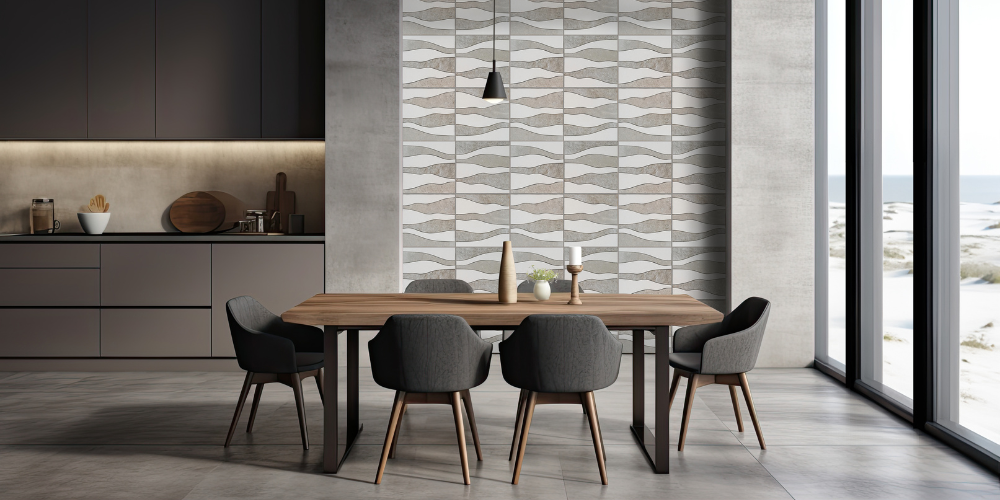
Partnership realises circular model for the Bornholm-based start-up, Dewdrop Tiles ApS.
In 2019, Rocío Paniagua Jensen was on a routine inspection at BOFA’s recycling site as part of her job as a municipal architect. Suddenly, something caught her attention; tile offcuts sitting and waiting to be scrapped. Rocío’s years of experience within architecture and the circular economy immediately made her see the potential in cutting them down and transforming them into new designs.
– I realised the environmental benefit hidden in these mountains of good materials, Rocío says. – Having already worked with mosaics for several years, the idea of cutting the tiles to size and assembling them into a new product seemed obvious.
Rocío decided to pursue her vision and launched the company Dewdrop Tiles ApS.
– Even though I knew my idea was good, it was a challenge at first. It was time-consuming to hand-cut the tiles, and besides, I lacked material volume. Therefore, I started by making individual tile motifs.
A crucial moment came when Rocío one day decided to knock on the door of the nationwide builders' merchant STARK. To her great delight, a meeting was immediately arranged with STARK's sustainability project manager, Kent Fonseca, who subsequently agreed to a major collaboration.
– STARK's security of supply was the missing piece, and Kent's experience regarding their own work in leading the way in the circular economy was invaluable, says Rocío.
Fundraising and supply
In connection with the beginning of her collaboration with STARK, Rocío applied for and received 450,000 kroner via Realdania’s campaign ’Innovation to Market’ – the funds were received earlier this year.
The campaign helps companies with new sustainable solutions to go from a fully developed solution to a product on the market – in other words, the difficult and costly scaling process. Certain sustainability and environmental friendliness requirements are attached to this support.
– The money is a big help and is going to be used to test a scalable mini-production on Bornholm, and we are well under way with that now, says Rocío.
– STARK can supply virtually endless quantities of materials in the form of surplus batches. When I need something, I call, and then an extra pallet goes on the lorry to their stores on Bornholm, which was going anyway, explains Rocío, elaborating on why the surplus tiles cannot be sold as they are: – The leftover tiles come from different firings and cannot be mixed with one another. As a tile merchant, you get complaints if there is the slightest inconsistency, and therefore they usually end up being crushed.
If there are any offcuts from construction companies on Bornholm, Rocío would be very happy to receive them, and if customers have their own tiles, they can also get help transforming them into new patterns or products.
– We have already had our first customers – both private individuals and businesses – including a job for Lærlingenes Hus in Tejn, which has been supplied with wall tiles for the bathrooms, kitchen and utility room made from leftover tiles from STARK, Byg-Grønt ApS, Garant Rønne and Michaels Murerforretning ApS. There were nine different types of tile in the piles I received for the project, and altogether it would have amounted to 300 kilos of waste had they not been reused.
Major CO2 reduction
Dewdrop Tiles reduce CO₂ emissions by 97.8 % compared with the production of traditional tiles. See the life cycle assessment at dewdroptiles.dk
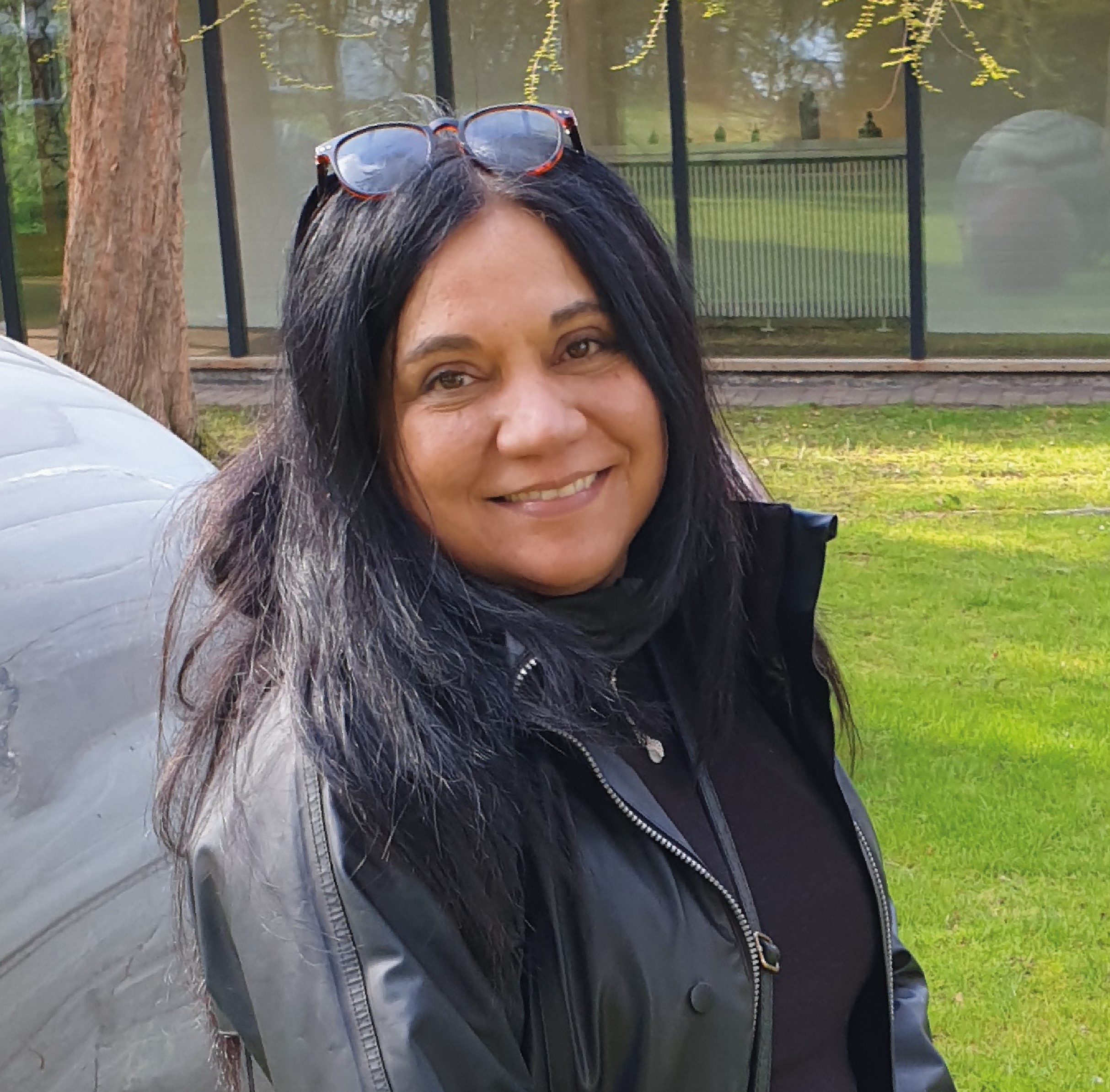
Rocío Paniagua Jensen, architect MAA, is the founder and director of Dewdrop Tiles ApS. She previously participated in BCB’s entrepreneurship programme ’588’, which was held in the autumn of 2018 and the spring of 2019. The programme included coaching and mentoring that helped the entrepreneurs realise their ideas. Photo: private
The recycling process
When Dewdrop Tiles ApS receives leftover tiles from its various partners, a digital classification is carried out first and foremost, giving Rocío an overview that she can easily choose from when she needs to mix the tiles in an attractive way and design new patterns.
– When we register where the materials come from, we simultaneously record the history of the products and the potential environmental savings, she explains.
Along with the tiles, the customer will therefore also receive a detailed description of where the tiles originally came from and the CO₂ savings achieved by reusing them.
– Dewdrop Tiles ApS works with documented environmental conservation. We’ve had a life cycle assessment made where we can document that this is very environmentally friendly and at the same time provides a saving compared to if you buy new tiles.
The tile offcuts are cut using a digital system at Maskinfabrikken Trio Nexø, which is situated next to the start-up hub Møbelfabrikken, where Dewdrop Tiles ApS is based. They are then mounted onto mesh in modules that correspond to standard tile sizes.
– The discarded tile offcuts we work with have never been used before and are just as durable as those you’d normally find on the market – so there’s no risk in buying them, and it makes good sense from an environmental perspective,’ says Rocío, adding that Dewdrop Tiles ApS’s current range consists solely of wall tiles, but that the company hopes to expand to include floor tiles in the long term.
– There are special characteristics of floor tiles that require documentation. Therefore, we are starting with the production of wall tiles – we want to do this right, she emphasises.
Dewdrop Tiles ApS has just launched a new website with concrete examples of how to use the tiles.
– We also have a showroom where you can see the products in action, concludes Rocío, adding that she has no doubt about what the most important approach is for a business owner who wants to work circularly: – Circular business models require partnership and collaboration. Therefore, you must be proactive and open to sharing your thoughts and ideas with others. What is waste for one company can become another's raw material.
BY TINA TOFT MØLLER
About Dewdrop Tiles ApS
Dewdrop Tiles ApS is a local start-up that has entered into a partnership with STARK to be able to scale up its business. The collaboration is proof that major players in the industry also see the value of sustainable solutions. Dewdrop Tiles’ studio is located in building no. 6 at Gammel Rønnevej 17D, 3730 Nexø, part of Iværksætterhuset Bornholm, Møbelfabrikken. Open by appointment, where you can experience their products created from recycled tile offcuts. The products can also be found at STARK Frederiksberg on C. F. Richs Vej 111, 2000 Frederiksberg.
See more at dewdroptiles.dk