

The energy solutions of the future are to be developed on Bornholm
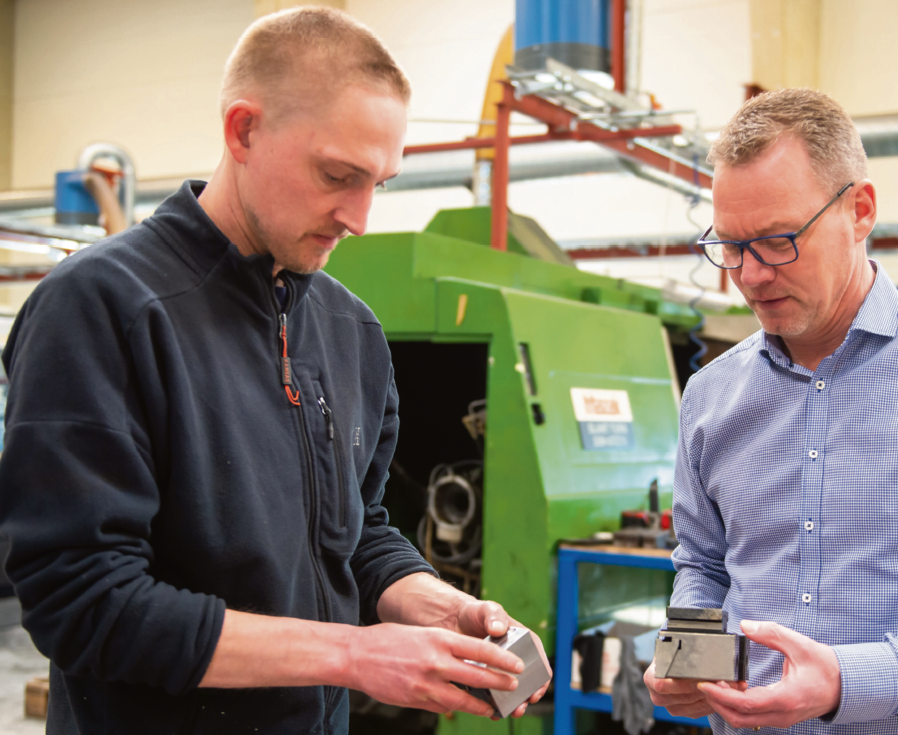
Since 2022, the National Centre for Green Energy project has been working on establishing a residential college on Bornholm, and during this start-up phase, several DTU students have already been linked to green business projects.
Bornholm is on its way to becoming the world's first energy island and making Denmark a frontrunner in the advanced utilisation of offshore wind, Power-to-X and other green energy initiatives.
In this connection, the Technical University of Denmark (DTU) is collaborating with, among others, the National Centre for Green Energy (Baltic Energy Island) project, other universities, Campus Bornholm and Business Center Bornholm on a residential college on the island, through which students and researchers will be connected to local business projects within the green transition, data and digitalisation.
Residential College Bornholm is expected to be housed in the old Rønne Power Station alongside a number of other functions connected to Baltic Energy Island, but despite the physical location not being entirely in place yet, the activities for Residential College Bornholm are well underway.
In November 2022, DTU and Business Center Bornholm held the first after-work meeting for Bornholm businesses about the opportunities, and since then several local businesses have participated in programmes with students who have shed light on the potential for innovative energy solutions.
Several companies have subsequently accepted an offer of future collaboration with students from DTU and other universities.
– We always have exciting ideas up our sleeve, and in this case we asked the students to explore how solar panels could be integrated in an alternative way, as we do not want to plaster the roof with them.
New knowledge
One of these companies is KH Maskinfabrik ApS, which works with structures, solutions, and products in steel and plastic. For a period of two months, the company had five DTU students attached.
Director Claus Duevang says:
– We always have exciting ideas in the drawer, and in this case we asked the students to explore how solar panels could be integrated in an alternative way, because we don't want to plaster the roof with them. They found a really great solution for utilising solar energy in an area where you could expand vertically and horizontally.
Although the project has not yet gained significant traction at KH Maskinfabrik ApS, the company intends to use parts of the solution. However, they must first test it on a small scale before proceeding further.
One challenge with the project has been that it has run for a short time, so the company has not gained the same benefit as if they had had the students for a longer period. Nevertheless, Claus Duevang thinks it is valuable to welcome students as interns in the company.
– I have been a student myself once and know that it is better to work with real-world projects.
At the same time, it was exciting, fun and interesting to have students
in the house, when they came with new input and the latest knowledge.
– The internship was arranged with the help of consultants from DTU
Business Center Bornholm, which handled the dissemination of a job advertisement
for students of various relevant academic specialisations.
High academic standard
Another company that has benefited from a DTU intern,
the Bornholm-based Sensemakers ApS, which works with environmental technology
solutions. Finding the right match was in
otherwise a smooth process.
That is according to Søren Femmer Jensen, co-founder of Sensemakers
ApS
– The internship was arranged with the help of consultants from DTU
Business Center Bornholm, which handled the dissemination of a job advertisement
for students of various relevant academic specialisations.
Hereafter, Sensemakers received applications from a number of
student. A personal interview was subsequently conducted
prior to concluding the placement agreement.
He adds:
– The duties have involved programming and development
of an automatic navigation and control system for a maritime
drone. The intern has also participated in the execution of
testing of the physical equipment with Sensemaker's in-house developed
hardware components.
How has the internship period benefited Sensemakers ApS?,
and how has it contributed to the company's goals and mission?
– As a start-up in a high-tech field, it
been a great help to be able to work with a highly qualified
technically skilled student. After a short settling-in period,
interns have had the opportunity to deliver real solutions and contribute
for the company's development. The professional standard has been
really loud, and has without doubt been a push forward towards Sensemaker’s
aim to deliver automated solutions within
monitoring of environment and nature.
Will you consider having more interns from DTU in the future, and
in that case, how will you ensure that these internships are successful
for both parties?
– We will certainly look into the possibilities of getting more
interns from DTU in the future and strengthen our innovative
development environment even more. We are – and will continue to be – very
open up to using some of the ”state-of-the-art” knowledge and inspiration
students can contribute.
BY TINA TOFT MØLLER
What is a residential college?
An offer for students on undergraduate and postgraduate programmes
on study stays outside the larger cities with a close connection to
local private and public enterprises.
Source: Universities Denmark